 English
 русский
 Español
 عربى
عربى


Label Application Machines: Complete Guide to Types, Selection and ROI
2026-09-09
Content
- 1 How a Label Application Machine Works, Subsystem by Subsystem
- 2 The Main Types of Label Application Machines and Where Each One Fits
- 3 Matching the Machine to Your Container Shape
- 4 Manual, Semi-Automatic, or Fully Automatic: Matching Automation to Volume
- 5 The Specifications That Deserve the Closest Scrutiny
- 6 Common Labeling Problems and the Fixes Experienced Operators Use First
- 7 What a Label Application Machine Really Costs and When It Pays Back
- 8 Why the Manufacturer Behind the Machine Matters
- 9 Frequently Asked Questions
- 9.1 How accurate is a typical label application machine?
- 9.2 Can one machine handle several bottle sizes and shapes?
- 9.3 What should I prepare before asking a supplier for a quotation?
- 9.4 Do transparent labels on clear bottles need special equipment?
- 9.5 How long do installation and commissioning take?
- 9.6 What operator skills does a label applicator need?
- 10 A Practical Checklist Before You Order
A label application machine earns its place on your floor the moment your volume passes roughly 20 to 30 containers per minute, or the moment crooked, wrinkled labels start generating rejected batches. These machines bond self-adhesive labels to bottles, jars, tubes, boxes, pouches, and pails with a repeatability no manual worker can hold across a full shift, at speeds ranging from about 20 pieces per minute on a tabletop unit to several hundred per minute on rotary systems. The difficult decision is not whether to automate. It is matching the right machine type to your container shape, your label material, and your genuine production volume. This guide explains how these machines work, which type fits which packaging format, the specifications that deserve the closest scrutiny, the problems you are most likely to meet on the line, and the questions worth putting to any supplier before you place an order.
How a Label Application Machine Works, Subsystem by Subsystem
Every label applicator, from a benchtop unit to a rotary system, is built from the same four subsystems. Understanding them makes every later decision, from speed ratings to spare parts, far easier to judge.
- Product handling. A conveyor, spacing wheel, or timing screw separates containers so each one is labeled on its own, at a predictable position and speed.
- Detection. A product sensor tells the control system that a container has arrived, while a label sensor locates the gap between labels on the backing liner.
- Label dispensing. The liner is pulled over a peel plate, where the backing curves away sharply and the label is drawn off, ready for presentation.
- Application and pressing. A belt, pad, roller, or air blast transfers the label onto the container and smooths it down so the adhesive bonds fully.
The complete cycle runs like this:
- A container enters the machine and is separated from the ones before and after it.
- The product sensor triggers the control system at the calibrated moment.
- The drive advances the liner and peels the leading edge of the next label.
- The applicator transfers the label to the container at the matched speed.
- A pressing belt, pad, or wrap motion smooths the label, and the machine awaits the next trigger.
Wipe-On, Tamp, and Blow-On Applicators
Three application methods cover nearly all situations. Wipe-on applicators brush the label onto a moving container and suit wrap-around labeling of bottles on a conveyor. Tamp applicators press a full label onto a stationary product with a padded cylinder, which works well for flat faces and recessed areas. Blow-on applicators use a puff of air to snap the label onto delicate or lightweight products such as pouches and thin films. The choice among them is mostly decided by whether your product is moving, fragile, or both.
The Main Types of Label Application Machines and Where Each One Fits
Machines are usually named after the container they label or the position where the label lands. The table below maps the most common types to their typical use. Output figures are mid-range values commonly quoted in supplier specification sheets; your real numbers will depend on container diameter, label height, and how steadily product arrives at the machine.
| Machine Type | Typical Container or Surface | Typical Mid-Range Output | Where It Fits Best |
|---|---|---|---|
| Tabletop labeling machine | Bottles, vials, small jars at a workbench | 20 to 40 pieces per minute | Laboratories, startups, short production runs |
| Round bottle labeling machine | Cylindrical bottles, cans, jars | 30 to 150 pieces per minute | Beverage, food, and daily chemical lines |
| Double side labeling machine | Flat-sided and oval bottles | 30 to 120 pieces per minute | Shampoo, detergent, and condiment bottles |
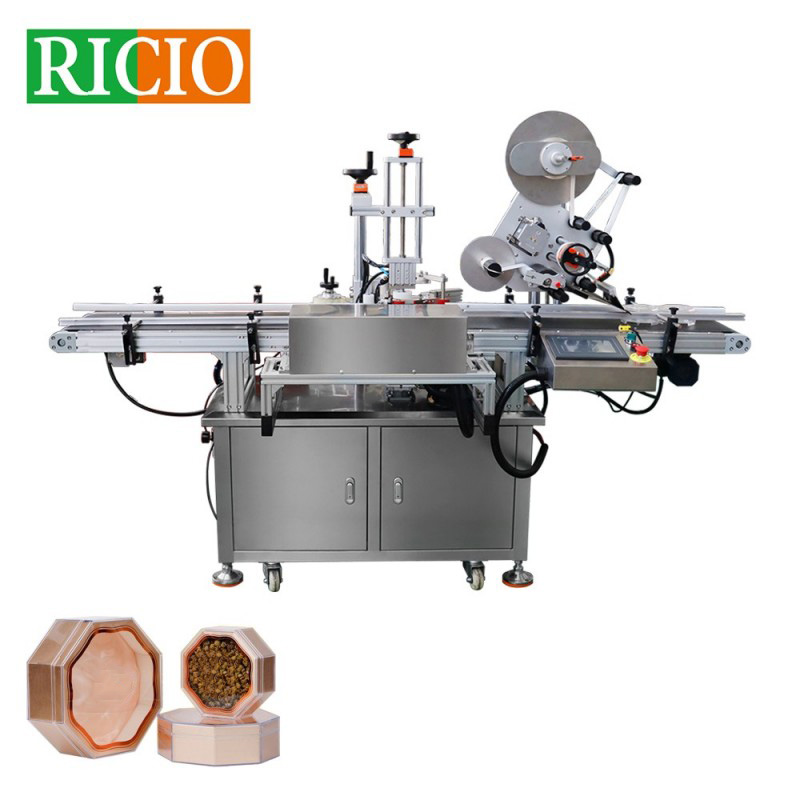
| Top labeling machine | Box tops, lids, flat pouch surfaces | 20 to 100 pieces per minute | Cartons, trays, and flat packs |
| Bottom labeling machine | Container undersides | 20 to 80 pieces per minute | Trays and containers needing underside markings |
| Tube labeling machine | Cosmetic and ointment tubes | 30 to 100 pieces per minute | Cosmetics, hand creams, pharmaceutical tubes |
| Pouch labeling machine | Stand-up pouches and bags | 20 to 80 pieces per minute | Snacks, coffee, and refill packs |
| Bucket labeling machine | Pails and tubs from 1 to 20 liters | 15 to 60 pieces per minute | Paint, lubricants, and bulk food packs |
| Rotary labeling machine | High-speed stable bottle flow | 150 to 400 pieces per minute | Beverage plants running dedicated lines |
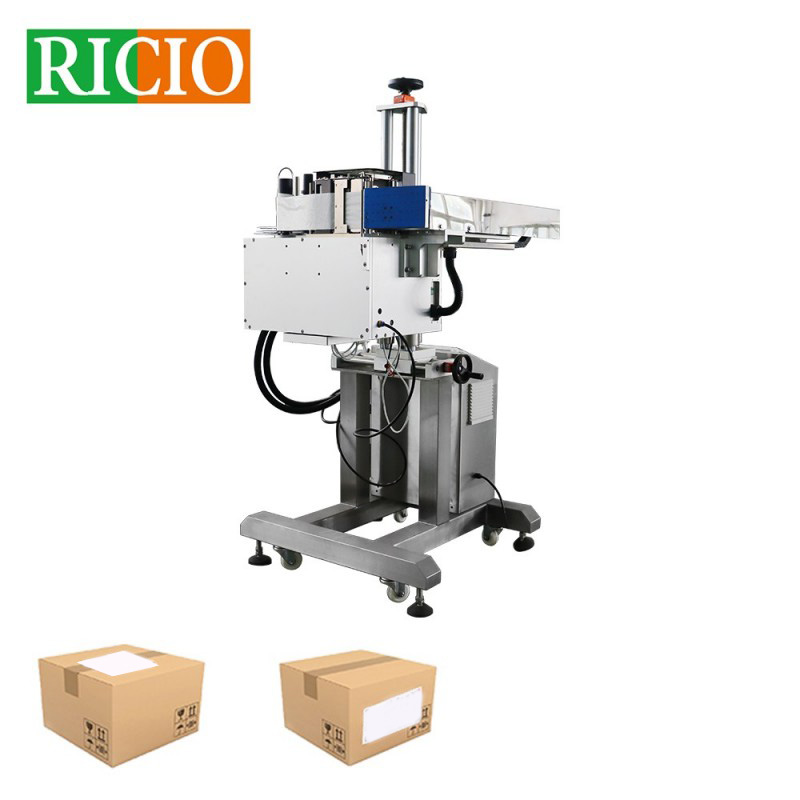
| Print and apply system | Cartons, shrink-wrapped packs, pallets | 20 to 60 pieces per minute | Logistics, batch and date coding at case level |
Two observations help narrow the field quickly. First, container shape matters more than industry: a flat-sided shampoo bottle and a flat-sided detergent bottle need essentially the same machine. Second, your peak rate, not your average rate, sets the machine class. A line that averages 60 pieces per minute but spikes to 90 needs equipment rated for the spike.
Matching the Machine to Your Container Shape
Container geometry decides the applicator arrangement more than any other factor. The differences below are where most purchasing mistakes happen, so measure carefully before you inquire.
Round Bottles and Cans
Cylindrical containers are labeled wrap-around style: the bottle rotates between a pressing pad and a powered wrap belt while the label is fed on. Uniform cylinders are the easiest case in the industry. Tapered containers need an angled applicator head and carefully adjusted wrap pressure so the label does not ride up or bunch at one end. For containers below roughly 25 mm in diameter, flagging, where the label ends lift away from the glass or plastic, becomes the main risk to manage, usually through softer, more conformable label stock.
Square, Flat-Sided, and Oval Bottles
Flat-sided bottles take labels on one or both faces. A single side machine with a corner-wrap arrangement folds the label gently around one edge, while a double side machine applies front and back labels simultaneously. Both rely on reliable bottle separation, because if two bottles pass as one, the labels land across the wrong panels. Oval containers add another wrinkle: pressure must be light and even, or the label telescopes around the curve.
Flat Surfaces, Tubes, and Pouches
Boxes, lids, and tray surfaces are handled by top labeling machines with a padded press or belt. Tubes arrive lying down and are rotated so the label lands on the flat panel rather than the shoulder. Pouches and bags need the lightest contact of all, which is where blow-on application earns its keep, since firm pressing can crush or distort the fill inside.
Clear Containers and Clear Labels
Transparent on transparent is the classic trouble combination. Standard optical label sensors struggle to see a clear liner, so an ultrasonic label sensor is normally specified, and container detection on fully clear bottles also deserves review. Raise transparent materials at the inquiry stage rather than after delivery, because retrofitting sensors later costs more and delays production.
Manual, Semi-Automatic, or Fully Automatic: Matching Automation to Volume
Not every producer needs an inline system, and buying more automation than the schedule justifies ties up budget and floor space. The levels break down like this:
- Manual dispenser. The operator pulls the liner by hand and places each label. Output reaches about 15 pieces per minute in short bursts, which suits volumes under a few hundred units per day.
- Tabletop semi-automatic. The operator places and removes the container while the machine peels and applies. Typical sustained output is 20 to 40 pieces per minute, covering several hundred to a few thousand units per day.
- Inline automatic. The machine sits on the production conveyor and labels continuously without an operator at the point of application, from roughly 30 to 150 pieces per minute and beyond.
- Rotary system. A star wheel carries containers through the labeling stations, reaching 150 to 400 pieces per minute for dedicated high-volume lines.
A practical rule: automate when labeling labor can no longer keep pace with your filling or packing rate, not merely when labels annoy your team. A semi-automatic tabletop machine often bridges the gap for growing producers because it delivers consistent placement while keeping investment and floor space modest, and it can be shifted to a new line or product without engineering work.
The Specifications That Deserve the Closest Scrutiny
Specification sheets look similar until production starts. The seven items below are where the differences between a smooth installation and a permanent headache tend to hide. Confirm every one of them in writing, ideally with a live test on your own containers and labels.
| Specification | Why It Matters | What to Confirm |
|---|---|---|
| Labeling accuracy | Placement consistency drives shelf appearance | Documented repeatability within 0.5 to 1 mm on your container |
| Rated speed vs line speed | No headroom means bottlenecks later | Rating at least 20 percent above your peak line speed |
| Label roll capacity | Small rolls mean constant changeovers | Standard 76 mm core, outer diameter of 300 mm or more |
| Container size range | Future SKUs should fit the same machine | Your next planned sizes covered without new parts |
| Changeover procedure | Mixed production lives on fast switches | Tool-free adjustments and recipe memory on the interface |
| Sensor types | Clear materials defeat optical sensors | Ultrasonic label sensor if liner or container is transparent |
| Construction and spares | Wear parts decide long-term uptime | Stainless or anodized wear parts, stocked spares list |
Pay special attention to speed headroom. A machine rated exactly at your current peak rate has nothing left for seasonal surges, slightly taller labels, or the natural slowdown of worn belts. Sizing at least 20 percent above the highest rate you expect to run is standard practice among experienced line engineers, and it costs very little at purchase time.
Common Labeling Problems and the Fixes Experienced Operators Use First
Almost every labeling complaint falls into one of six patterns. Before adjusting anything on the machine, check the two cheapest variables: label quality and container consistency. Wavy liners, poorly wound rolls, and dented containers cause more labeling faults than genuine machinery defects.
| Problem | Usual Cause | Practical Fix |
|---|---|---|
| Wrinkles around a round bottle | Applicator and wrap belt speeds out of sync | Match wrap belt speed to conveyor speed and ease off wrap tension |
| Bubbles under the label | Label face larger than the flat panel | Choose a label 2 to 3 mm smaller than the flat face and increase press pressure slightly |
| Label ends lifting, called flagging | Label material too stiff for the radius | Switch to a thinner or more conformable film |
| Placement drifting through the shift | Product sensor catching irregular containers | Reposition the sensor and review container spacing |
| Clear labels not detected | Optical sensor cannot see a clear liner | Fit an ultrasonic label sensor |
| Static making labels cling or curl | Dry plastic containers and low humidity | Add an ionizing air blower before the application point |
Keep a simple log for two weeks after installation: date, product, symptom, and the adjustment made. Patterns appear quickly, and the log turns every future changeover from guesswork into a written recipe your whole team can follow.
What a Label Application Machine Really Costs and When It Pays Back
Labor is the clearest saving, so it is worth working through an illustrative example. Suppose manual labeling manages 12 pieces per minute with one operator before fatigue sets in, which is a realistic sustained figure over a full shift. Eight productive hours per day yields under 6,000 units. A semi-automatic tabletop unit run by that same single operator commonly sustains 30 pieces per minute, roughly 14,000 units per day, tripling output without adding headcount. At a fully loaded labor cost of 20 US dollars per hour, the machine removes the need for a second or third labeling worker as volume grows, which for most producers is the largest single saving.
Three quieter savings follow. First, consistent placement reduces rejected goods, because a crooked label often means a scrapped unit even when the product inside is perfect. Second, predictable label position supports dependable barcode scanning downstream at warehouses and retail checkouts, protecting you from chargebacks and rescan labor. Third, on mixed-SKU plants, changeover time quietly governs effective capacity; a machine that switches formats in minutes returns hours of production every week compared with one that does not.
Payback periods under a year are commonly reported by producers running steady volumes above roughly 2,000 units per day, though the exact figure depends on labor costs and shift patterns in your market. Treat any payback promise made without your own volume data with caution, and run the arithmetic on your real numbers before committing.
Why the Manufacturer Behind the Machine Matters
Two suppliers can offer machines with identical specification sheets and deliver completely different ownership experiences. The difference usually comes down to how the equipment is built and who answers when something wears out. Assemblers that buy complete component sets and bolt them together can struggle to reproduce a replacement bracket or roller years later. A source manufacturer that machines its own core parts simply makes another one.
Shanghai RICIO Packaging Technology Co., Ltd is an example of this second category. The company built its manufacturing base on the acquisition of a long-established Shanghai machining workshop, which gave it in-house CNC machining of core components alongside final assembly and testing. Its catalog spans the full range described in this article, from tabletop and round bottle machines through double side, tube, pouch, bucket, top, bottom, and rotary systems, plus real-time print-and-apply units for logistics work. Industry coverage runs from food, beverage, and nutraceuticals to pharmaceuticals, cosmetics, daily chemicals, and chemical drums, and the company offers custom systems for containers that sit outside standard machine ranges. For a buyer, the practical significance is straightforward: one supplier can handle a laboratory tabletop machine today and a high-speed line later, with parts and adjustments drawn from its own machining floor.
Whichever supplier you evaluate, four requests will reveal most of what you need to know:
- Ask to see your own containers and labels running on the machine, recorded on video, before shipment.
- Request the wear parts list with prices and delivery times, not just the machine price.
- Ask who guides your team through adjustments after installation, and whether remote video support is available.
- Confirm the changeover steps in writing so your operators can repeat them without the supplier on the phone.
Frequently Asked Questions
How accurate is a typical label application machine?
Well-adjusted equipment holds placement within 0.5 to 1 mm on consistent containers, which is the target most manufacturers work to. Keep in mind that container consistency matters as much as the machine: a bottle whose diameter varies will produce varying label heights even on a perfect applicator. Check your containers before blaming the machine.
Can one machine handle several bottle sizes and shapes?
Yes, within its stated adjustment range. Most inline machines cover a diameter span of roughly 30 to 120 mm and a height range of 40 to 300 mm through tool-free adjustments, though exact figures vary by model. The better question is changeover time, because a machine that handles all your sizes but takes an hour to switch between them will hurt a mixed-product schedule far more than a narrower range ever would.
What should I prepare before asking a supplier for a quotation?
Gather full container dimensions including any taper, label dimensions with liner material and unwind direction, your target output per minute, the line layout with available length, your factory power standard, and photos or physical samples. Suppliers who receive this package can quote accurately, and they often flag container issues before those issues become order problems.
Do transparent labels on clear bottles need special equipment?
In most cases, yes. Standard optical label sensors cannot reliably see a clear liner, so an ultrasonic label sensor is specified instead, and container detection on fully transparent bottles may also need review. Mention transparent materials at the inquiry stage; adding them after delivery usually means replacing sensors and retesting the whole application point.
How long do installation and commissioning take?
A tabletop unit typically runs within an hour of unboxing. An inline machine usually needs one to three days covering conveyor alignment, sensor calibration, speed matching, and operator training, provided your containers and labels match what the supplier tested. A factory test run on your actual samples before shipment is the single best way to shorten on-site time.
What operator skills does a label applicator need?
Daily operation is straightforward: load label rolls, confirm placement against a master sample, and watch for liner breaks. The skill worth investing in is changeover and first-line fault finding. Train two people rather than one, because that protects your schedule during absences and shift handovers.
A Practical Checklist Before You Order
A short checklist keeps the buying process honest and the installation quick.
- Write down your true peak rate, including the growth you expect over the next two years.
- Collect full container drawings, including tapers, neck profiles, and panel positions.
- Confirm label dimensions, material, and unwind direction with your label printer.
- Ask the supplier to run your actual containers and labels on the machine and record the video.
- Verify the spare parts list and the lead times for wear components such as belts and sensors.
- Train two operators and document the changeover steps for every product you run.
- Keep headroom by selecting a rated speed at least 20 percent above your peak.
Label application machines are mature, well-understood equipment. The buyers who end up disappointed are almost always the ones who ordered on brochure numbers alone. Run your own containers, keep speed headroom, secure the spare parts, and the machine will quietly do its job for a decade or more.
related products
related News
 +86 13681850339
 sales@raxpack.com
 Building 6, No. 477 Tiefeng Road, Baoshan District, Shanghai, China
- Tabletop Labeling Machine
- Round Bottle Labeling Machine
- Automatic Tube Labeling Machine
- Pouch Labeling Machine
- Rotary Labeling Machine
- Syringe Labeling Machine
- Top Labeling Machine
- Single Side Sticker Labeling Machine
- Double Side Labeling Machine
- Bucket Labeling Machine
- Bottom Labeling Machine
- Corner Label Applicator
- Waist Sealing Labeling Machine
- Square Bottle Labeling Machine
