 English
 русский
 Español
 عربى
عربى


Print & Apply Label Applicator: How It Works, Selection Tips, and Cost-Efficiency in 2026
2026-09-28
Content
- 1 What Is a Print & Apply Label Applicator?
- 2 Core Working Principles of a Print & Apply System
- 3 Key Benefits That Drive Adoption
- 4 How to Choose the Right Print & Apply Label Applicator
- 5 Common Applications Across Industries
- 6 Frequently Asked Questions About Print & Apply Label Applicators
- 7 Final Verdict
A beverage bottler running 120 cases per minute must print a unique barcode, lot number, and expiry date on every carton. A pharmaceutical contract packer needs to apply serialized labels to 300 syringes per minute without a single misread. In both scenarios, a print & apply label applicator is the only viable solution. This machine combines a thermal transfer or inkjet printer with an automatic label applicator, printing variable information in real time and applying it to moving products or packaging in one seamless cycle.
Below we first answer the core question — what exactly is a print & apply system and why it dominates modern production lines — then break down the technology, selection criteria, typical applications, and common pitfalls. We draw on real-world manufacturing data and the expertise of machinery builders like RICIO to keep every point actionable.
What Is a Print & Apply Label Applicator?
A print & apply label applicator is an integrated system that performs two functions in one pass:
- Prints variable data (barcodes, lot numbers, expiry dates, serial numbers, graphics) onto blank label stock using a thermal transfer, direct thermal, or inkjet print engine.
- Applies the freshly printed label onto a product, case, pallet, or bag using one of three common application methods: blow-on, tamp-blow, or wipe-on.
Unlike pre-printed labels that must be ordered, inventoried, and manually applied (or fed to a separate labeler), a print & apply system eliminates label inventory waste and enables on-demand, custom labeling. According to a 2025 industry benchmark study by PMMI, facilities that switched from pre-printed labels to print-on-demand systems reduced label-related downtime by 37% and saved an average of $0.02 per label in material and changeover costs.
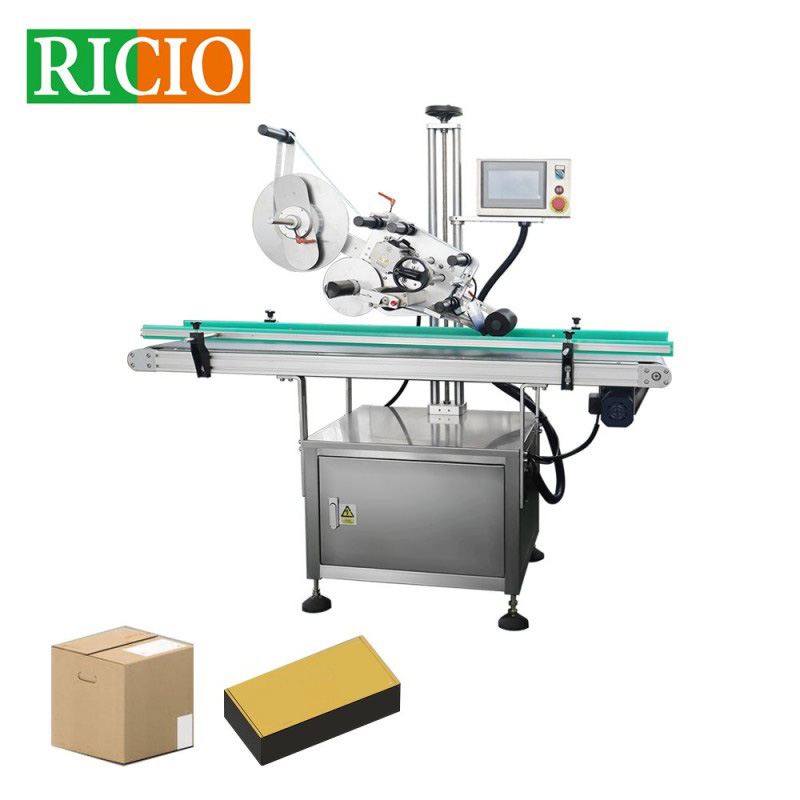
RICIO’s 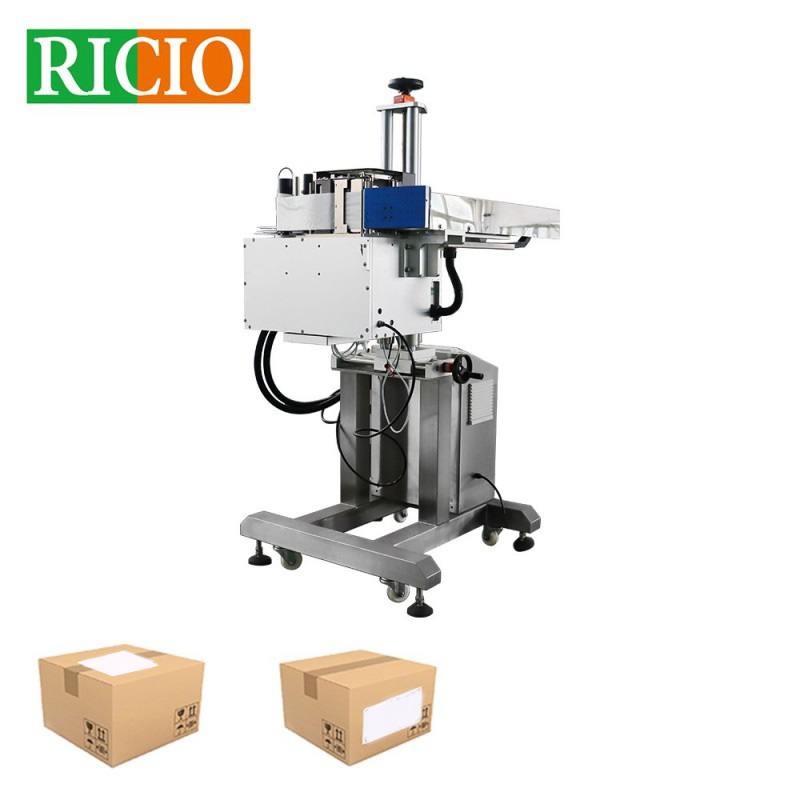 Integrated Print and Apply Label Applicator with TTPThis unit combines a thermal transfer printer with tamp-blow application, reaching up to 60 labels per minute. Ideal for real-time variable data on boxes and flat surfaces, it serves as the core example in our selection discussion.View Product → is a representative unit that integrates a standard thermal transfer printer with a tamp-blow applicator, achieving up to 60 labels per minute on boxes and flat surfaces. For higher speeds or specialty containers, modular configurations are available — a topic we cover in the selection section.
Core Working Principles of a Print & Apply System
Print Engine
The heart of the system is the print engine. Most industrial print & apply machines use thermal transfer printing (TTP) because it produces durable, high-contrast barcodes resistant to smudging and moisture. Print resolution typically ranges from 203 dpi (standard for most logistics labels) to 300 dpi or 600 dpi (needed for pharmaceutical serialization). Print speed directly affects overall throughput: a typical engine prints 6–12 inches per second, which translates to 30–80 labels per minute depending on label size.
Applicator Module
Three application technologies dominate the market:
| Method | Action | Best For | Typical Throughput |
|---|---|---|---|
| Blow-on | Compressed air blows label onto surface from a short distance | Fragile products, irregular shapes | 20–40 labels/min |
| Tamp-blow | Pad extends, picks label, then extends and blows it onto product | Recessed surfaces, variable product height | 25–60 labels/min |
| Wipe-on / Roll-on | Label transferred onto product using a brush or roller | Flat surfaces, high-speed lines | Up to 120 labels/min |
For most case-taping and carton-labeling applications, a tamp-blow or wipe-on module offers the best balance of speed and placement accuracy (±1 mm). If you are labeling curved containers such as round bottles, a dedicated beverage labeling system might be more suitable, but for flat or semi-flat surfaces, a print & apply unit is hard to beat.
Key Benefits That Drive Adoption
- Zero pre-printed label inventory – Print only what you need, when you need it. One roll of blank stock can serve thousands of different SKUs.
- Real-time data integration – The system receives variable data from a database, ERP, or vision system, ensuring each label contains correct lot numbers, barcodes, and serial numbers.
- Reduced labor cost – A single operator can oversee multiple print & apply lines. One major US food manufacturer reported saving 3 full-time equivalent (FTE) positions after installing eight print & apply units on its case-packing lines.
- Compliance and traceability – Industries like pharmaceutical, medical device, and automotive require unique device identifiers (UDI) or GS1-128 barcodes. Print & apply systems are the most cost-effective way to meet these regulatory demands.
- Flexibility for different label sizes – Most machines accept label widths from 20 mm to 150 mm without hardware change, reducing changeover time to under five minutes.
How to Choose the Right Print & Apply Label Applicator
Buying a print & apply system involves evaluating several parameters. Below is a practical checklist used by RICIO’s engineers when consulting customers.
- Throughput requirement – How many labels per minute must the machine apply? For under 40/min, blow-on is sufficient; for 40–80/min, choose tamp-blow; above 80/min, a wipe-on module or a rotary applicator is needed.
- Label size and material – Thermal transfer labels require a ribbon; direct thermal labels (often used for short shelf-life applications) need no ribbon. The print width must equal or exceed your label width.
- Application surface – Flat, curved, recessed, or protruding. Tamp-blow works best on recessed or uneven surfaces; wipe-on is ideal for flat, moving cases.
- Environmental conditions – For cold or moist environments (e.g., meat processing), choose a system with an IP54-rated cabinet and heated printhead to prevent condensation.
- Integration with existing line – Does the machine need to communicate with a conveyor controller, a barcode scanner, or a vision system? Most modern print & apply systems support EtherNet/IP, Profinet, or simple PLC I/O.
- Total cost of ownership – Consider ribbon usage (vs. direct thermal), label waste, and maintenance frequency. A high-quality print engine with a metal frame can last 10+ years; cheaper plastic units may need replacement after 3–4 years.
RICIO’s product range includes a 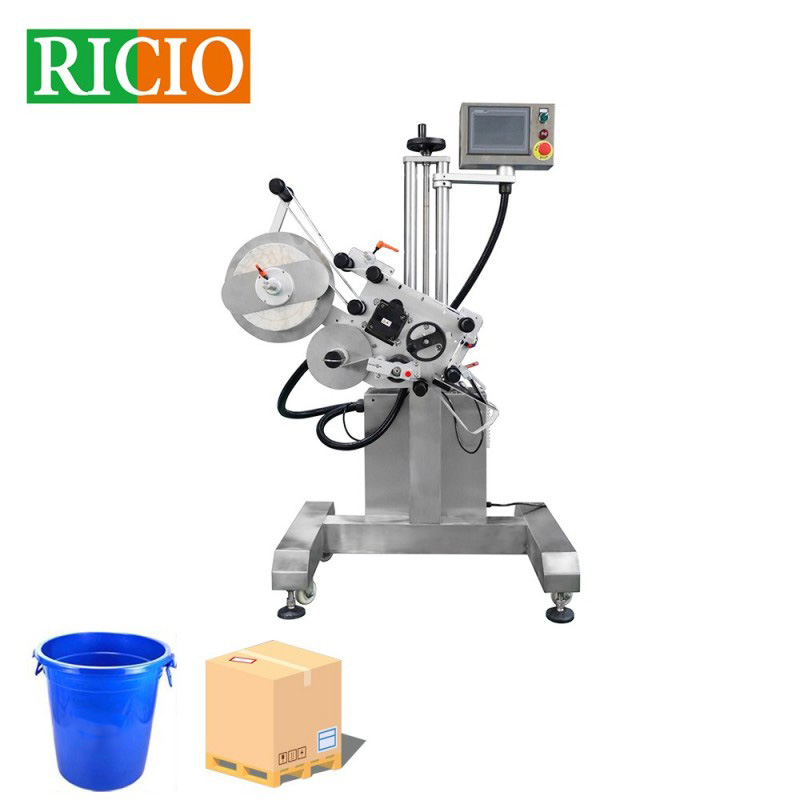 Inline Labeling Machine for Production LinesDesigned for seamless integration with existing conveyors, this machine applies pre-printed labels to product tops. Its stepless speed adjustment and automatic stop function make it a flexible alternative to dedicated print-and-apply systems.View Product → that can be paired with a print engine for print-and-apply functionality, though the dedicated print & apply unit is the more integrated choice for most factories.
Common Applications Across Industries
Print & apply label applicators are most commonly deployed in:
| Industry | Common Label Content | Typical Placement | Regulatory Standard |
|---|---|---|---|
| Logistics & Warehousing | Shipping addresses, GS1-128 barcodes, weight | Top or side of corrugated boxes | GS1 Logistics Label |
| Food & Beverage | Best-before date, lot number, batch code | Side of cases, ends of trays | FDA 21 CFR Part 11 |
| Pharmaceutical | Unique serial numbers, GTIN, expiry, batch | Top or side of cartons, bundles | UDI, EU FMD, DSCSA |
| Chemical & Pesticide | Hazard pictograms, batch, net weight | Side of drums, pails | GHS, CLP |
| Cosmetics | Brand logo, lot, expiry | Side of tubes, bottles (pre-printed often preferred; print & apply used for outer cartons) | — |
For more specialized workflows — such as labeling small vials or syringes — a dedicated 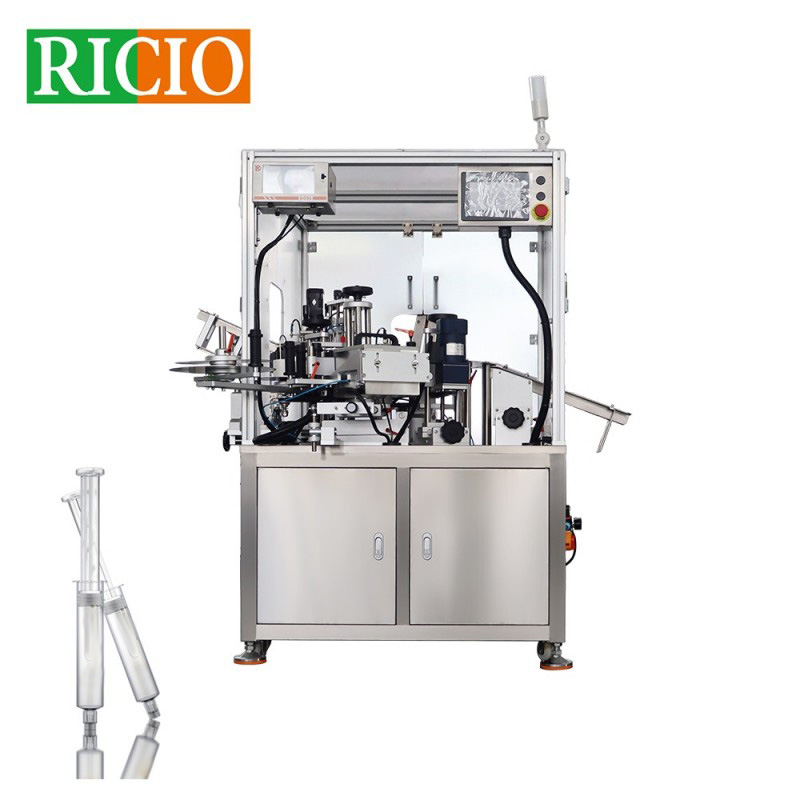 Automatic Syringe Labeling Machine for Small VialsWith star wheel positioning and intermittent operation, this machine precisely labels syringes and tubular medical products (diameter 8–20 mm). It offers better accuracy than general-purpose print-and-apply units for specialized pharmaceutical tasks.View Product → may offer better precision than a general-purpose print & apply unit. However, for the vast majority of case, carton, and bag labeling tasks, a print & apply system provides the best blend of speed, flexibility, and cost control.
Frequently Asked Questions About Print & Apply Label Applicators
Q: What is the typical lifespan of a print & apply applicator?
A: With proper maintenance — including regular printhead cleaning, platen roller replacement, and lubrication — a heavy-duty unit can operate 8–12 years. The print engine itself may need rebuild after 5–7 years of continuous use. RICIO offers spare part kits and remote support to extend machine life.
Q: Can a print & apply system handle small labels (e.g., 25×25 mm)?
A: Yes, but the label material must be on a narrow liner (minimum 25 mm width). Blow-on or tamp-blow modules work well for small labels. The print engine must support the required narrow media; most industrial engines accommodate down to 20 mm width. Always test with your actual label stock before purchase.
Q: What is the difference between print & apply and a label printer applicator?
A: The terms are used interchangeably. “Print & apply” emphasizes the workflow (print then apply), while “label printer applicator” describes the hardware. Some vendors use “printer applicator” for stand-alone units that can be integrated into a line, and “print & apply system” for a complete solution with conveyor and controls. But functionally they are the same.
Q: How do I maintain the printhead of a thermal transfer print & apply machine?
A: Use isopropyl alcohol wipes daily to remove ribbon residue. Replace the printhead when barcode scannability drops below the industry threshold (e.g., GS1 Grade C). Most manufacturers recommend a printhead life of 30–50 km of printed label length. RICIO’s machines feature a tool-less printhead removal for quick swaps.
Q: Can I use synthetic or polypropylene labels with a print & apply system?
A: Yes. Synthetic labels (e.g., polypropylene, polyester) work well with thermal transfer printing. Ensure the ribbon is formulated for synthetic materials (wax-resin or resin) to achieve good adhesion and abrasion resistance. Direct thermal labels are usually paper-based and not suitable for harsh environments.
Q: What conveyor speed do I need to match a print & apply applicator?
A: The conveyor should be adjustable. As a rule of thumb, the distance between products on the conveyor must be at least two times the label height to give the applicator time to retract. Most systems can handle line speeds up to 30 m/min. RICIO provides an integration guide that calculates required spacing based on label dimension and print speed.
Final Verdict
A print & apply label applicator is no longer a luxury for high-volume lines — it is a cost-competitive, compliance-enabling standard for any facility that ships multiple SKUs or requires variable data labeling. The key is to match the applicator method, print engine, and environmental rating to your specific application. RICIO’s dedicated print & apply units, along with its broader labeling portfolio, demonstrate how a modular approach can serve both straightforward carton labeling and complex pharmaceutical serialization.
To explore how a print & apply system can reduce your per-label cost, eliminate pre-printed inventory, and improve traceability, consult the technical datasheet of RICIO’s Integrated Print and Apply Label Applicator with TTPThis unit combines a thermal transfer printer with tamp-blow application, reaching up to 60 labels per minute. Ideal for real-time variable data on boxes and flat surfaces, it serves as the core example in our selection discussion.View Product → or request a live demonstration with your actual product samples.
related products
related News
 +86 13681850339
 sales@raxpack.com
 Building 6, No. 477 Tiefeng Road, Baoshan District, Shanghai, China
- Tabletop Labeling Machine
- Round Bottle Labeling Machine
- Automatic Tube Labeling Machine
- Pouch Labeling Machine
- Rotary Labeling Machine
- Syringe Labeling Machine
- Top Labeling Machine
- Single Side Sticker Labeling Machine
- Double Side Labeling Machine
- Bucket Labeling Machine
- Bottom Labeling Machine
- Corner Label Applicator
- Waist Sealing Labeling Machine
- Square Bottle Labeling Machine
