 English
 русский
 Español
 عربى



Table Top Label Applicator: Applications, Selection Criteria, and Practical Guidance
2026-10-26
Content
- 1 What a Table Top Label Applicator Does
- 2 Positioning Versus Non-Positioning: Decide This First
- 3 Typical Specifications and What Each One Means
- 4 Speed Planning: What 30 Labels per Minute Really Means
- 5 Which Containers Work With a Table Top Label Applicator
- 6 Three Industries That Rely Heavily on Benchtop Labelers
- 7 Buying Checklist: Eight Points to Verify Before You Order
- 8 Five Setup Mistakes That Ruin Label Placement
- 9 Frequently Asked Questions About Table Top Label Applicators
- 9.1 Can a table top label applicator label square bottles?
- 9.2 What label materials can a benchtop labeler handle?
- 9.3 How long does a size changeover take?
- 9.4 Do I need compressed air on the production floor?
- 9.5 How often should the machine be maintained?
- 9.6 What is the realistic accuracy of a benchtop labeler?
- 10 The Bottom Line: Match the Machine to the Bottle and the Batch
Suppose a cosmetics manufacturer fills 300 ml lotion bottles in runs of 2,000 units. The operator currently peels pressure-sensitive labels from a release liner by hand and presses each one onto the bottle. Realistic output is 10 to 14 bottles per minute, and an occasional crooked edge is discovered only when a consumer complaint arrives. Replacing that step with a table top label applicator raises output to 20 to 40 bottles per minute and keeps placement repeatability near ±1 mm, the practical threshold for an attractive round-bottle pack.
The direct conclusion: if your containers are round, your batch size lies between roughly 500 and 10,000 units, and a full automatic line is not yet justified, a benchtop label applicator is the right investment. The product family is mature, the operating principle is proven, and the differences between one machine and another come down to a short list of specification points. This guide explains those points with the numbers you need for a purchase decision: positioning, bottle diameter range, speed planning, changeover, setup errors, and maintenance expectations.
What a Table Top Label Applicator Does
A table top label applicator, also called a benchtop labeler or semi-automatic labeling machine, is a compact unit that sits on a workstation and applies self-adhesive labels to a container the operator places at the label station. The machine consists of four functional groups: the label reel holder and tensioning rollers, the stripping plate where the label separates from its liner, the photoelectric sensor that reads the gaps between labels, and the driven silicone roller that presses the label onto the rotating container.
The operating sequence is short. The sensor detects the gap between labels and stops the reel at the correct position, the front edge of the label is pushed into contact with the bottle wall, and the bottle is rotated against the driven roller until the label is wrapped around the full circumference. On a RICIO benchtop unit this cycle runs at 20 to 40 bottles per minute, depending on bottle diameter and label length, which is fast enough to replace an entire manual labeling station.
Everything else you need to evaluate a tabletop machine is connected to this sequence. Bottle rotation speed determines cycle time. Sensor adjustment determines whether the machine misreads glossy or transparent label stock. The distance between the stripping plate and the bottle surface determines how tightly the label hugs the container wall. These details rarely appear in a brochure, which is why the next sections cover them explicitly.
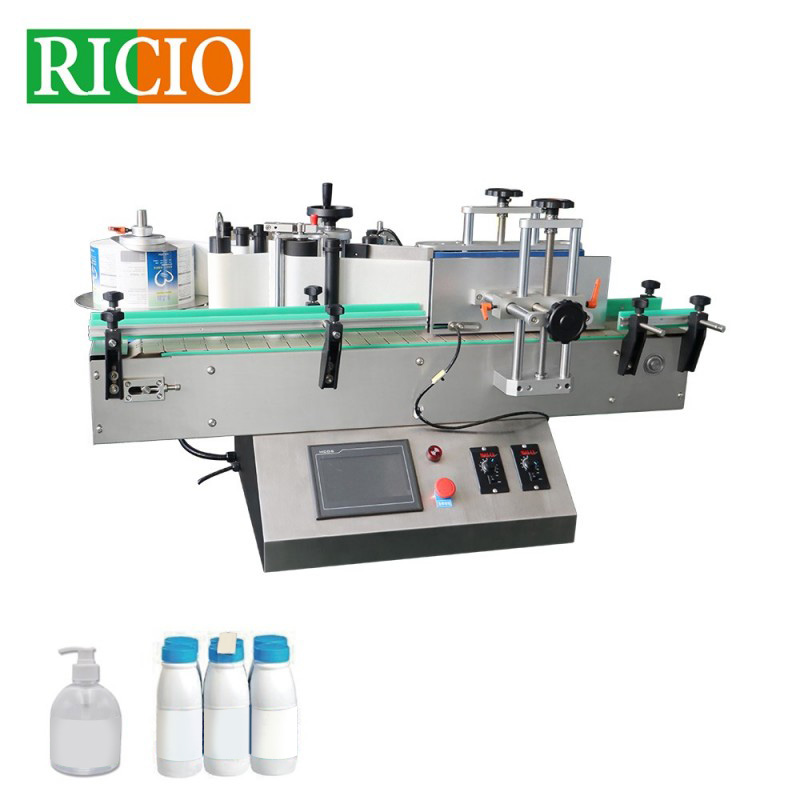 Automatic Round Bottle Tabletop Labeling Machine for Compact LinesThis compact benchtop labeler suits small to medium lines needing consistent round-bottle labeling. It handles full or partial wrap at 20–100 bottles per minute with ±1mm accuracy, and can integrate coding options.View Product →
Positioning Versus Non-Positioning: Decide This First
Not every benchtop labeler places the label at the same angular position on every bottle. The distinction between a positioning machine and a non-positioning machine is the most overlooked item on a purchase order, and it cannot be retrofitted later.
A non-positioning table top label applicator starts rotating the bottle the moment the bottle touches the drive roller. The label lands at a slightly different start point each time, which is acceptable for plain cylindrical containers, full-wrap labels with no seam alignment requirement, and bottles where every side looks the same. A positioning tabletop labeling machine adds an extra sensor, a servo control scheme and a locating stop that rotates each bottle to the same start angle before the label is released, so the leading edge of the label lands at exactly the same point on every unit.
You need the positioning version when the container has a weld seam that would look unprofessional beneath the label, a frosted glass panel that must face forward, an embossed logo, or a printed film label that has to align with itself around a tapered wall. When in doubt, choose the positioning model. The price difference is small compared with the cost of relabeling a rejected batch of several thousand bottles.
For most cosmetic bottles and beverage bottles with a visible mould seam, the positioning benchtop machine is the safer default. If your job is plain cylinders such as candle jars, honey pots or paint cans with a solid-color label, the non-positioning unit delivers the same appearance at a lower cost.
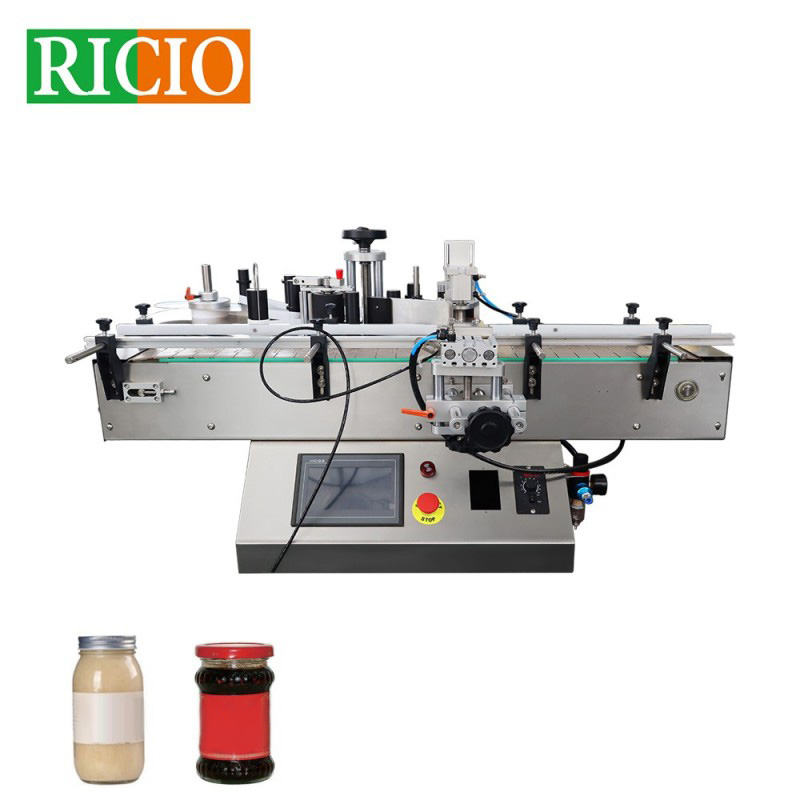 Positioning Tabletop Labeler for Round Bottles with Mould SeamsFor bottles requiring consistent label placement relative to a mould seam or feature, this positioning unit ensures repeatable angular alignment. It offers similar speed and accuracy while accommodating customization for bottle and label dimensions.View Product →
Typical Specifications and What Each One Means
The table below lists the working ranges you can expect from a current table top label applicator. Use these values for planning a bench area, estimating output and checking whether your label dimensions fit before you request a quote.
| Parameter | Typical Range | Why It Matters |
|---|---|---|
| Bottle diameter | 25-100 mm | Defines which containers can be run without additional change parts. |
| Label height | 10-150 mm | Limited by the width of the stripping plate and the driven roller. |
| Label length | 20-300 mm | Longer labels need more bottle circumference and slow the cycle slightly. |
| Output | 20-40 bottles/min | Realistic figures with one operator feeding and removing bottles. |
| Placement repeatability | ±1 mm | The variation you can see with the naked eye; below this you need the positioning model. |
| Air supply | 0.4-0.6 MPa | Compressed air drives the pneumatic cylinders and the wipe-on roller. |
| Power supply | 220 V or 110 V, about 200 W | Confirm voltage before quoting; a standard power outlet is sufficient. |
The exact limits depend on the model. RICIO offers two benchtop configurations: a lighter non-positioning unit and a positioning benchtop labeler with servo control. They differ in the low end of the bottle diameter range and in the design of the change parts. Before ordering, send the supplier a sample bottle and the actual label reel, and ask for a written placement test result.
Speed Planning: What 30 Labels per Minute Really Means
Manufacturers quote machine capability, but the number that matters for your production plan is shift output with an operator in the loop. A benchtop machine can cycle at 30 labels per minute, yet the operator must pick up a bottle, place it against the rollers, remove the labeled bottle and pack it. In practice, plan with an efficiency factor of 70 to 80 percent.
Here is a realistic calculation. At 30 labels per minute, the gross output is 1,800 labels per hour. At 75 percent utilization, usable output is about 1,350 labels per hour. Over an 8-hour shift with two 20-minute breaks, that is approximately 9,900 labeled bottles. The same batch done by hand at 12 bottles per minute would take about 14 hours, or two shifts with a second operator.
The comparison below positions the tabletop machine in the broader automation ladder.
| Method | Realistic Output | Placement Consistency | Investment Level |
|---|---|---|---|
| Hand application | 8-15 bottles/min | Operator dependent | None |
| Table top applicator | 20-40 bottles/min | ±1 mm | Low to medium |
| Full automatic line | 60-300 bottles/min | ±0.5 mm | High |
The payback math follows the same logic. Assume an operator cost of 20 dollars per hour including overhead. Replacing hand labeling at 12 bottles per minute with a tabletop machine at 30 bottles per minute saves roughly 6.5 hours of labor on a 10,000-bottle batch. At 200 batches per year, that is approximately 26,000 dollars of labor saving annually, against a machine investment that is typically recovered in less than 12 months.
Which Containers Work With a Table Top Label Applicator
A tabletop machine is a round-bottle specialist. Within that category, the practical range is wider than many buyers assume, but there are clear boundaries.
- Cylindrical plastic bottles between 25 mm and 100 mm in diameter, from 30 ml cosmetic bottles to 1-liter beverage bottles.
- Round glass jars with a straight or slightly tapered wall, such as honey jars, candle jars and cosmetic cream jars.
- Vials and small bottles at the lower end of the diameter range, provided the label length does not exceed a single wrap.
- Tapered round containers with a small cone angle, where the label is applied in the middle zone and folds naturally onto the surface.
What does not fit a tabletop unit? Square and rectangular bottles cannot rotate around a single vertical axis, so they need a flat-surface or double-side labeling machine instead. Extremely small ampoules and vials below 10 mm are better handled by a horizontal small-bottle labeler. Containers with deep curves, such as oval detergent bottles, sit somewhere in between and need a sample test on the actual machine. For a full survey of bottle-specific options, see the round bottle labeling index on this site.
Three Industries That Rely Heavily on Benchtop Labelers
Cosmetics and Personal Care
Lotion pumps, serum droppers, nail polish bottles and hair oil containers share the same pattern: small to medium batches, frequent label artwork changes, and strict visual standards. A tabletop machine gives cosmetic fillers independence from manual labor without committing to a high-speed line. Product runs of 500 to 5,000 units are exactly where the benchtop class wins on cost per label. See how this fits the wider cosmetics labeling workflow for full-line planning.
Pharmaceutical and Supplement Packaging
Medicine bottles, vitamin jars and drop-dispenser bottles demand repeatable label position, clean edges and fast changeover between batch sizes. The positioning benchtop labeler is a common choice for contract packers that handle many small runs. Because changeovers happen several times per shift, the servo-controlled positioning model with tool-free adjustment saves the most time over a production week.
Food, Sauce and Condiment Production
Honey jars, jam pots, hot-sauce bottles and sample-size condiment containers rarely justify a full automatic wrapper in a small kitchen or a specialty food facility. A tabletop labeler positioned directly after the capping table is the configuration we most often see in this segment. Operators feed bottles immediately after filling, and the labeler keeps up with a filler operating at moderate speed.
Buying Checklist: Eight Points to Verify Before You Order
- Compare your smallest and largest bottle against the machine parameter table, not just the average bottle on your line. The low-diameter end is where poorly chosen machines fail.
- Define the positioning requirement before comparing prices. A non-positioning price looks attractive until you run a seam bottle.
- Confirm voltage and air supply: 110 V or 220 V, compressor capacity at 0.4 to 0.6 MPa, and the available load on the bench circuit.
- Measure the bench footprint including the label reel overhang on the back of the machine. A typical tabletop unit needs about 800 by 700 mm plus clearance for the operator's hands.
- Ask for a change-part price list for the next bottle size you plan to run. Change parts are not free, and a second set usually pays for itself in changeover time within three months.
- Verify sensor compatibility with your label stock: transparent film, glossy foil and matte paper reflect light differently, and the photoelectric sensor must be adjustable for each.
- Check the standard reel core inner diameter, normally 75 mm, and the maximum outer reel diameter the holder accepts. Larger reels reduce the frequency of reel changes.
- Request a sample run with your own bottle and label before accepting delivery. A written placement report covering 20 consecutive bottles tells you more than any brochure.
Five Setup Mistakes That Ruin Label Placement
Most label defects on benchtop machines are not caused by the hardware. They come from five setup mistakes that appear again and again on production floors.
- Incorrect label reel tension. Too much tension stretches the liner and causes the label to lift at the edges; too little tension creates slack that shifts the label position. Set the brake so that the reel stops without overrun.
- Bottle center height misalignment. If the vertical position of the bottle center is not aligned with the driven roller center, the label wraps in a spiral. Adjust the bench height or the bottle guide before adjusting anything else.
- Sensor threshold set for the wrong label surface. Glossy labels reflect a strong signal, while matte or textured labels need a different threshold. Always recalibrate when switching label material.
- Ignoring die-cut quality of the label. Labels with burrs or incomplete die cuts lift at the stripping plate and cause a jam every few cycles. A cheap label reel can turn a 30 per minute machine into a 10 per minute machine.
- Changing bottle diameter without resetting the guide rails. The guides are not a one-time adjustment. Each new bottle diameter needs a fresh gap setting equal to the bottle diameter plus 1 to 2 mm clearance.
Frequently Asked Questions About Table Top Label Applicators
Can a table top label applicator label square bottles?
No. A square or rectangular bottle cannot rotate around a single axis, so the label would wrap unevenly. Square and flat packs need a flat-surface labeling machine, a single-side labeler or a double-side labeler depending on how many sides carry a label.
What label materials can a benchtop labeler handle?
Paper labels, polypropylene film, polyethylene film, PET labels and most foil labels, as long as the material can be wound on a 75 mm core and stripped from a release liner without tearing. Transparent materials require a sensor with adjustable threshold and good contrast marks on the liner.
How long does a size changeover take?
With tool-free guides, a typical bottle diameter and label size changeover takes 10 to 20 minutes for a non-positioning unit and slightly longer for a positioning unit. With a second set of change parts, the mechanical time drops to under 5 minutes.
Do I need compressed air on the production floor?
Most benchtop labelers use pneumatic cylinders for the wiping action and the bottle clamping functions, so the minimum requirement is normally 0.4 to 0.6 MPa of clean, dry compressed air. If your facility has no compressor, specify an all-electric servo version at the inquiry stage.
How often should the machine be maintained?
At least a light cleaning every shift: remove adhesive residue from the stripping plate and rollers, check the sensor window, and inspect the drive belt for wear. A full preventive check once a month keeps the placement accuracy at the original level.
What is the realistic accuracy of a benchtop labeler?
For a non-positioning machine, plan around ±1 mm placement variation. For a positioning machine with servo control, the leading-edge position repeats within a tighter band, typically ±0.5 mm on stable round bottles with consistent dimensions.
The Bottom Line: Match the Machine to the Bottle and the Batch
Choose by container, then by positioning, then by changeover. If the container is round and the batch is in the hundreds or low thousands, a table top label applicator is the most capital-efficient way to remove manual labeling from the process. If the bottle has a seam, an embossed feature or a printed label that must align, choose the positioning model. If the bottle is a plain cylinder with a standard wrap label, the simpler benchtop unit will do the job at a lower budget.
The last step, and the one most buyers skip, is the sample test. Send your real bottle and your real label reel to the manufacturer, ask for 20 consecutively labeled samples, and measure the placement on each one. That 30-minute test will tell you more about the machine than any specification sheet, because it combines the three variables that matter: bottle tolerance, label die-cut quality and machine adjustment.
related products
related News
 +86 13681850339
 sales@raxpack.com
 Building 6, No. 477 Tiefeng Road, Baoshan District, Shanghai, China
- Tabletop Labeling Machine
- Round Bottle Labeling Machine
- Automatic Tube Labeling Machine
- Pouch Labeling Machine
- Rotary Labeling Machine
- Syringe Labeling Machine
- Top Labeling Machine
- Single Side Sticker Labeling Machine
- Double Side Labeling Machine
- Bucket Labeling Machine
- Bottom Labeling Machine
- Corner Label Applicator
- Waist Sealing Labeling Machine
- Square Bottle Labeling Machine
