 English
 русский
 Español
 عربى



Hand Labelling: When Manual Labelling Beats Machines and Where the Break-Even Point Sits
2026-11-02
Content
- 1 When Hand Labelling Beats Buying a Machine
- 2 The Break-Even Arithmetic Behind Hand Labelling
- 3 What Hand Labelling Can Realistically Achieve on Placement Tolerance
- 4 Which Containers Cooperate With Hand Labelling
- 5 Hand-Held Applicators, Bench Dispensers and Fixtures: What You Actually Need
- 6 Roll Labels or Sheet Labels: Why It Changes Everything
- 7 A Repeatable Hand Labelling Procedure
- 8 Six Mistakes That Quietly Raise the Cost of Hand Labelling
- 9 When to Move From Hand Labelling to Semi-Automatic
- 10 Buying Checklist for Manual and Semi-Automatic Labelling Equipment
- 11 Frequently Asked Questions About Hand Labelling
- 11.1 What does hand labelling actually mean?
- 11.2 How accurate is hand labelling compared with a machine?
- 11.3 How many labels can one person apply per hour?
- 11.4 Is hand labelling cheaper than buying a machine?
- 11.5 Do I need special tools to label by hand?
- 11.6 Can round bottles be labelled by hand?
- 11.7 Why do labels lift at the corners after hand application?
- 11.8 At what point should I stop labelling by hand?
If you are standing at a bench with a stack of labels and a row of containers, the useful question is not whether hand labelling is "good enough". It is how long it stays the cheapest way to get labels onto your product. For most operations running below roughly 20,000 to 30,000 labels a month, hand labelling remains the correct answer, provided the labels, the tooling and the technique are set up properly. Past about 50,000 labels a month, or as soon as placement tolerance becomes tight, the labour hours stop being cheap and the balance shifts toward semi-automatic equipment.
That is the short version. The sections below break down where the break-even point actually sits, what placement accuracy you can realistically hold by hand, which container shapes cooperate and which ones fight back, and how to build a manual process that does not drift from one operator to the next.
When Hand Labelling Beats Buying a Machine
The conclusion first: hand labelling wins whenever you are paying for flexibility rather than speed. A machine earns its keep when it runs, and it loses money when it sits idle or gets re-adjusted for the next SKU. If your production pattern looks like any of the following, a manual or hand-supported process is not a compromise, it is simply the cheaper build.
- Volumes under about 20,000 labels a month. A semi-automatic label applicator plus infeed guidance is a real capital purchase, while manual labour is paid by the hour and only when you actually run the batch.
- Frequent changeovers. Switching a manual bench from one bottle to another takes seconds. Switching a machine means moving guide rails, repositioning the applicator head and re-teaching sensors, which commonly costs 15 to 45 minutes per change depending on how different the two containers are.
- Odd shapes and short-run SKUs. Custom bottles, lipstick tubes, syringes or one-off gift packs rarely justify a dedicated feeding solution when each run is only a few hundred pieces.
- Sampling, trial runs and rework. Re-labelling a misaligned bottle by hand costs nothing. Creating a new machine recipe to fix a handful of units costs a great deal of time.
The honest limitation is consistency. Two people doing the same job by hand will not place a label within the same millimetre of each other, and the same person will not hold the same tolerance at nine in the morning and at five in the afternoon. Where that variation is visible to the customer or to an inspection camera, the manual route has a hard ceiling.
The Break-Even Arithmetic Behind Hand Labelling
Published figures for manual throughput vary widely because the job depends on label size, liner release and how fussy the alignment has to be. A working figure of 300 to 500 labels per hour covers most manual benches. Using 400 labels per hour as a planning number, the labour load looks like this.
| Monthly label volume | Hand labour per month | Setup that usually fits | Practical reason |
|---|---|---|---|
| Under 5,000 | About 12 hours | Hand application with a simple fixture | Any machine cost never amortises at this volume |
| 5,000 to 20,000 | 12 to 50 hours | Hand-held applicator plus a roll dispenser | Hours stay manageable, consistency starts to slip |
| 20,000 to 60,000 | 50 to 150 hours | Semi-automatic bench or inline applicator | One person, most of their week, doing nothing else |
| Above 60,000 | Over 150 hours | Automatic labelling line | It has effectively become a full-time position |
Read the middle two rows carefully. At 20,000 labels a month the manual route already consumes over 50 hours, close to a working week for one person. At 60,000 it consumes roughly 150 hours, which is why most producers at that level either hire specifically for labelling or buy a machine. The transition rarely happens because the operator complains about speed. It happens because the labour line in the cost sheet becomes visible to whoever signs the purchase orders.
One adjustment worth making before you compare anything: add 20 to 40 percent to your theoretical hand-labelling hours. Container handling, liner changes, tape, cleaning and the occasional strip-and-replace all consume time that a clean calculation tends to ignore.
What Hand Labelling Can Realistically Achieve on Placement Tolerance
Start with the numbers, because they decide everything else. On a flat or gently curved surface, a trained operator working steadily can usually hold placement within plus or minus 1 to 2 millimetres. Rotate three people through the same shift and that spread widens to around plus or minus 3 millimetres. A semi-automatic applicator with a mechanical stop typically holds plus or minus 0.5 to 1 millimetre on the same part.
Where the Variation Comes From
- Sight line. Operators who align to a shoulder edge see a different reference than operators who align to a cap thread. If the reference is not written down, it changes between people.
- Thumb pressure. Pressing from the middle outward pushes air to the edges; pressing from one edge pushes air into a single trapped pocket.
- Liner release speed. Peel too quickly and the adhesive grabs before the label is in position; peel too slowly and the adhesive starts to set while the label is still moving.
- Ambient conditions. Adhesive tack responds to temperature. In an unheated warehouse in winter, the same label behaves differently than it does in a conditioned room.
What Fails First
Placement drift is rarely the first problem. Bubbles and wrinkles appear before position errors do, especially when paper labels are pressed onto any curved surface. Corner lift is second, and it usually traces back to a container that was not clean at the label contact point. Only after those two do most teams start noticing that the label sits a millimetre low on one side of the pallet and a millimetre high on the other.
For a shampoo bottle sold on a shelf, a one-millimetre difference is invisible and nobody should spend money chasing it. For a vial, a syringe or a product that passes an inspection camera, that same millimetre is a reject.
Which Containers Cooperate With Hand Labelling
Hand labelling is not a general-purpose method. It is good at some shapes and genuinely poor at others, and knowing the difference saves a lot of frustration. Flat and near-flat surfaces are where manual work is most competitive.
- Cartons and boxes with a defined edge to align against.
- Flat bottles and flat pouches, where the label has nowhere to curl.
- Tubes and cosmetic containers, where the cylinder diameter is large enough to press the label flat by hand.
- Tags, cards and bags, which are usually lightweight enough that a manual bench is fastest.
- Drums and pails at low volume, where the label is large but the batch size is small.
- Small vials and ampoules when a simple locating block holds the container steady.
Now the shapes that resist manual work. Bottles below roughly 30 millimetres in diameter are the classic problem, because the label has to wrap faster than a hand can smooth it. Anything requiring a wrap-around label with a controlled seam, a two-sided application with matching front and back positions, a corner placement, or a simultaneous top-and-bottom label will produce a visible mismatch long before it produces a usable batch. When the label needs to land in an exact orientation relative to a moulded feature on the container, hand work starts to look like guesswork. Visit the round bottle labelling section for the container class where this problem shows up most often.
Hand-Held Applicators, Bench Dispensers and Fixtures: What You Actually Need
Most teams that describe themselves as "labelling by hand" are really using one of four setups, and the choice between them changes throughput far more than operator skill does.
Bare Hands and Sheet Labels
The slowest and least consistent option. Every label must be peeled off a sheet, which means finger contact with the adhesive and a fresh alignment decision for every piece. It works for a few hundred units, not for a few thousand.
Hand-Held Label Applicators
A hand-held applicator feeds a roll of labels across a peel plate and lets the operator apply with one hand while the other steadies the container. It removes the peel-and-position split-second problem and typically lifts output meaningfully compared with bare hands, while keeping the operator free to reposition the container between pieces.
Bench Dispensers and Locating Fixtures
A bench dispenser holds the roll and presents the label at a fixed height. Add a locating block, a V-groove for round containers or a simple back stop, and the operator stops making alignment decisions altogether. This is the single highest-return upgrade available to a manual operation, and it costs a fraction of a machine.
Semi-Automatic Tabletop Units
When the volume climbs past the manual range but the budget and floor space do not justify a full line, a tabletop applicator is the middle ground. It drives the label onto the container at a controlled speed and lets the operator load and unload, which usually multiplies output several times over while bringing placement back into the sub-millimetre range.
 Automatic Round Bottle Tabletop Labeling Machine for Cylindrical ContainersA compact tabletop solution for round bottles, jars, and cans, with full- or partial-wrap labeling, touch-screen control, and optional coding; ideal when manual output no longer meets demand.View Product →
Whatever route you choose, check the peel plate geometry before anything else. A peel plate that releases the label too early forces the operator to catch it, and a plate that releases too late makes the label drag. Both problems cost more throughput than any difference in operator technique.
Roll Labels or Sheet Labels: Why It Changes Everything
This decision gets made early and then lives with you for years. Roll labels come on a liner that runs over a peel plate, so the label separates with a controlled motion and the adhesive surface never touches a finger. Sheet labels require individual peeling and are usually printed in small batches on a desktop printer.
- Roll labels scale with you. The same roll works on a hand-held applicator, a bench dispenser and a semi-automatic machine, so an upgrade does not force a reprint.
- Sheet labels win on very short runs. If you are producing 200 units of a seasonal variant, printing sheets on demand avoids a roll minimum order.
- Roll labels protect adhesive quality. Fingerprints and skin oils reduce initial tack, and that effect shows up as corner lift three days later on the pallet, not on the line.
If there is any chance the volume will grow, standardise on rolls. It costs slightly more per label at low volume and saves an entire migration project later.
A Repeatable Hand Labelling Procedure
Written procedures feel excessive for manual work, until you realise that three operators are using three different methods and producing three different results. A short, fixed sequence removes most of that variation.
- Clean the container at the label contact area. Dust, condensation and mould-release residue all reduce initial tack.
- Define one permanent alignment reference and mark it on the fixture. Never let the reference migrate to whatever is convenient that day.
- Set the peel plate so the leading edge of the label hangs just clear of the liner, ready to meet the container without the operator pulling.
- Hold the applicator in the dominant hand and the container in the other. Contact the leading edge first, then draw the applicator across while the container stays still.
- Smooth from the centre outward with the flat of the thumb, not the tip. This pushes trapped air to the edges rather than into a pocket.
- Inspect every unit briefly during handling rather than running a sample check at the end of the batch. A mislaid label caught immediately costs one strip; caught an hour later it costs an hour of rework.
- Reset alignment every 30 minutes, or whenever a new operator takes over the bench.
Six Mistakes That Quietly Raise the Cost of Hand Labelling
These are the ones that show up again and again. None of them looks serious on its own, and together they can add a third to your labour hours.
- Peeling with bare fingers. Every touch transfers oil to the adhesive. Corner lift appears on the pallet, not on the line, so it gets blamed on the label supplier.
- Pressing from the centre without an anchor. The label rotates slightly as it is smoothed and ends up angled relative to the container edge.
- Letting each operator choose a reference point. The batch looks consistent within one operator's output and inconsistent across the pallet.
- Stacking labelled units immediately. Pressure on a freshly applied label shifts it. Give the adhesive a few minutes of undisturbed contact.
- Skipping the rework count. If nobody logs how many labels get stripped and replaced, the true manual cost stays invisible and the make-or-buy decision gets made on bad numbers.
- Working in an unconditioned space. A cold room changes adhesive behaviour, and operators compensate by pressing harder, which creates wrinkles rather than better adhesion.
When to Move From Hand Labelling to Semi-Automatic
The conclusion is simpler than most buyers expect: once manual labelling consumes roughly half of a person's working month, a semi-automatic unit generally pays for itself within a year. The signal is not a throughput number, it is the point at which the labelling workload starts blocking other work.
Take a worked example. At 30,000 labels a month, hand application at 400 labels per hour consumes about 75 hours, or roughly three and a half hours every working day. A semi-automatic tabletop unit with manual loading typically brings that down to around 20 to 25 hours a month, because the machine controls label feed, peel and application speed while the operator only loads and unloads. The labour freed up is the return, and the improvement in placement consistency is a bonus that usually matters more to the quality team than to the finance team.
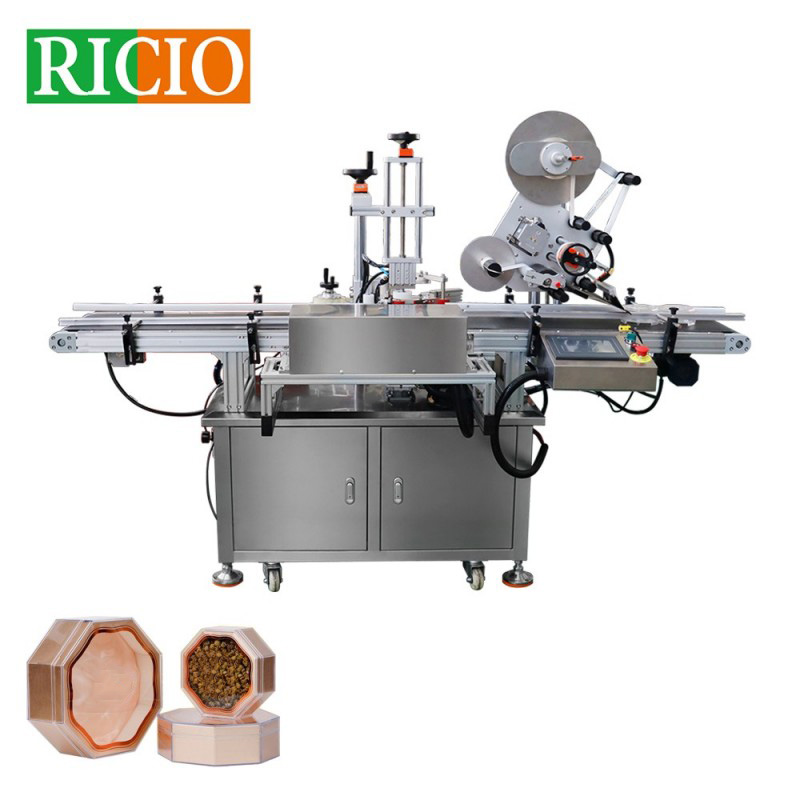
 Automatic Single Side Sticker Labeling Machine for Flat ContainersApplies front, side, or single-face labels to square, flat, irregular, and some round containers, with conveyor alignment, sensor-triggered dispensing, and stored touch-screen parameters for repeatable output.View Product →
Three other triggers are worth watching. First, when you start turning down orders because the labelling bench cannot keep up. Second, when a customer begins asking for placement measurements as part of incoming inspection. Third, when a single operator becomes the only person who can label a particular product correctly, because at that point you have a single point of failure rather than a process. For a broader view of how the equipment categories compare on speed, changeover and payback, the complete guide to label application machine types and ROI walks through the same trade-offs in more detail.
Buying Checklist for Manual and Semi-Automatic Labelling Equipment
Whether you are buying a hand-held applicator or a tabletop machine, the same questions decide whether the equipment will still be useful in three years.
- Label size range. Confirm the minimum and maximum label length and height the unit handles, and compare it against the biggest and smallest labels on your artwork list.
- Container diameter range. A unit that covers 20 millimetres to 100 millimetres will handle far more future SKUs than one locked to a single bottle size.
- Peel plate adjustability. Look for a plate that can be moved forward and back, and angled slightly. Fixed geometry only works with one label stock.
- Changeover time. Ask for the number of minutes to switch from one container format to another, and ask how many adjustments that involves.
- Application speed control. Being able to slow the machine down matters more than top speed, because inconsistent label stock is far more common than ideal label stock.
- Fixture availability. A locating block or V-groove for your container is worth more to consistency than any electronic feature.
- Serviceable parts. Peel plates, rollers and drive belts wear. Confirm that replacements are available and that the unit can be opened without special tooling.
Frequently Asked Questions About Hand Labelling
What does hand labelling actually mean?
It covers any labelling process where a person applies the label, whether that is peeling a sheet label with bare fingers, using a hand-held applicator fed from a roll, or working at a bench with a dispenser and a locating fixture. The term describes the application method, not the equipment level.
How accurate is hand labelling compared with a machine?
A steady operator can hold placement within roughly plus or minus 1 to 2 millimetres on a flat surface. Across multiple operators or a long shift, expect closer to plus or minus 3 millimetres. A semi-automatic applicator with a mechanical stop typically holds plus or minus 0.5 to 1 millimetre.
How many labels can one person apply per hour?
A practical planning range is 300 to 500 labels per hour, with the lower end applying to small labels on awkward containers and the upper end to larger labels on flat surfaces. Add 20 to 40 percent to any clean calculation to account for handling, liner changes and rework.
Is hand labelling cheaper than buying a machine?
Below roughly 20,000 labels a month, almost always yes. Between 20,000 and 60,000 the answer depends on your labour cost and how often you change products. Above 60,000 labels a month, the manual route consumes close to a full working month of one person's time, and a machine almost always wins.
Do I need special tools to label by hand?
No tools at all works for a few hundred pieces. Beyond that, a roll dispenser and a locating fixture deliver the largest improvement per unit of cost, because they remove the two decisions that consume the most time: where the label starts and how the container is oriented.
Can round bottles be labelled by hand?
They can, but the difficulty rises sharply as diameter falls. Above roughly 40 millimetres a careful operator can produce an acceptable wrap. Below 30 millimetres the curvature works against the label and wrinkles become routine, which is usually the point at which producers move that product to a machine.
Why do labels lift at the corners after hand application?
Three causes dominate: adhesive contamination from fingers, a dusty or damp container surface, and pressure applied immediately after labelling by stacking units too soon. Fixing those three removes the majority of corner-lift complaints without changing the label stock at all.
At what point should I stop labelling by hand?
When the manual workload reaches about half of one person's month, or when a customer begins measuring placement as part of incoming inspection, or when only one person on the team can run a particular product correctly. Any of those three is a stronger signal than a raw volume number.
Hand labelling is not a stage to be embarrassed about and it is not a permanent answer. It is a method with a clearly defined working range, and inside that range it beats expensive equipment on cost, changeover speed and flexibility. The practical move is to measure your own hours rather than your own impressions, put a fixture and a roll dispenser in place, and set a deliberate trigger point for the upgrade. Teams that do that end up with a manual process that is genuinely efficient, and a machine purchase that happens at the right moment instead of three years too early.
related products
related News
 +86 13681850339
 sales@raxpack.com
 Building 6, No. 477 Tiefeng Road, Baoshan District, Shanghai, China
- Tabletop Labeling Machine
- Round Bottle Labeling Machine
- Automatic Tube Labeling Machine
- Pouch Labeling Machine
- Rotary Labeling Machine
- Syringe Labeling Machine
- Top Labeling Machine
- Single Side Sticker Labeling Machine
- Double Side Labeling Machine
- Bucket Labeling Machine
- Bottom Labeling Machine
- Corner Label Applicator
- Waist Sealing Labeling Machine
- Square Bottle Labeling Machine
