 English
 русский
 Español
 عربى



Roll Fed Labeling Machine Guide: Web Path, Speeds, and Smart Buying Tips
2026-11-23
Content
- 1 How a Roll Fed Labeling Machine Moves a Label From Web to Container
- 2 Feed Format Comparison: Where Roll Fed Labeling Fits
- 3 Specifications to Fix Before You Request a Quote
- 4 Round Bottle Roll Fed Labeling: Wrap-Around With Orientation
- 5 Flat Surface, Carton, and Pouch Labeling
- 6 Top, Bottom, and Corner Labeling on Boxes and Pails
- 7 Label Rolls and Materials That Decide Your Uptime
- 8 Speed, Accuracy, and the Real Cost of Both
- 9 Controls and Sensors: Stepper or Servo, and Print-and-Apply
- 10 Line Layout and Integration Points Most Buyers Forget
- 11 Procurement Checklist and Common Buying Risks
- 12 Daily and Weekly Maintenance That Protects Placement Accuracy
- 13 Frequently Asked Questions
- 13.1 What is a roll fed labeling machine?
- 13.2 How fast can a roll fed labeling machine run?
- 13.3 What label roll sizes can these machines accept?
- 13.4 Can a roll fed labeler apply clear film or transparent labels?
- 13.5 How accurate is placement on a roll fed machine?
- 13.6 What happens if the label gap varies across the roll?
- 13.7 Is a servo feed worth the extra cost over a stepper?
- 13.8 How long does a changeover take?
- 13.9 Can the same machine label bottles and flat cartons?
- 13.10 What should I check before signing a purchase order?
A roll fed labeling machine pulls die-cut, pressure-sensitive labels from a continuous roll, peels each label off its liner at a peel plate, and applies it to a bottle, carton, tube, vial, or pail moving on a conveyor. If your label supplier ships labels on a roll and your products arrive already filled, this is the machine family you are shopping in, whether the catalog calls it a self-adhesive labeler, a sticker labeling machine, or a roll fed applicator.
The practical answer first: for output between roughly 30 and 250 pieces per minute, roll fed labeling is usually the lowest total cost route. It changes over in 5 to 15 minutes instead of the 20 to 60 minutes a wet glue line needs, it accepts paper, PP, PE, PET, and clear film labels, and it wastes only the labels consumed during setup. It gives ground on very high volume paper label beverage lines, where cut-and-stack wet glue machines still run in the 300 to 600 containers per minute range.
Second conclusion, and the one that saves the most money: placement drift on a roll fed line is more often a label web or product handling problem than an applicator problem. A die-cut pitch that varies by 1mm, a bottle that shifts 2mm sideways between the timing screw and the wipe-on belt, or a conveyor whose speed wanders by 3 percent will defeat a perfectly good labeling head. Settle those three variables before you compare machines.
How a Roll Fed Labeling Machine Moves a Label From Web to Container
The label never simply falls onto the container. It travels along a controlled path where web tension, registration, and application pressure are all pulling against each other. Understanding that path is what separates a machine you can run for three shifts from one that needs constant babysitting.
- Unwind. The roll sits on a spindle, most commonly on a 76mm (3 inch) core with a maximum roll outside diameter of 300 to 400mm. A friction brake or a small servo holds back tension so the web does not overrun when the drive stops.
- Tension control. A dancer arm, a spring-loaded roller, or a load cell keeps the web steady. Web tension in the range of 5 to 20 N suits most narrow label rolls; too loose and the label skews on the pad, too tight and thin liners stretch and the die-cut starts to tear.
- Registration. A photoelectric sensor reads the 2 to 4mm gap between labels, or a printed eye mark on printed film. The controller corrects the web position on every cycle, which is how the machine copes with pitch variation across a roll.
- Metering. A stepper or servo-driven roller advances the web by exactly one label pitch, typically 40 to 150mm per cycle on small bottle work. Servo metering adds an electronic cam so the web can slow during application and speed up between products.
- Peeling. The web turns sharply around a peel plate with a radius of roughly 1 to 3mm. Label stiffness keeps the label travelling straight while the liner follows the plate and dives away.
- Application. A wipe-on belt or roller presses the label onto a rotating container, a tamp pad pushes a label onto a stationary surface, or an air-blow head places a label at 0.5 to 2mm standoff without touching the product.
- Rewind. The empty liner winds onto a second spindle under constant torque. A slipping rewind leaves slack liner that snags, which is one of the most common causes of a mid-shift stoppage.
Wipe-On, Tamp, and Air Blow Compared
- Wipe-on: best for cylindrical containers from 20mm to 100mm diameter. Speed follows container rotation, so a round bottle can take a 200mm label in a single smooth pass.
- Tamp: best for flat cartons, pouches, cards, and box tops. Stroke is usually 5 to 15mm, and cycle time is fixed by the pad travel rather than the product.
- Air blow: best for fragile, irregular, or recessed surfaces where contact would move the product. Standoff distance and blow duration need tuning on each new label shape.
Feed Format Comparison: Where Roll Fed Labeling Fits
Buyers often compare labeling machines before they compare label supply formats. The supply format decides most of the running cost, the changeover time, and how much floor space the line needs.
| Feed format | Typical speed | Label materials | Changeover | Common use |
|---|---|---|---|---|
| Roll fed self-adhesive | 30 to 250 pcs/min | Paper, PP, PE, PET, clear film | 5 to 15 min | Beverage, pharma, cosmetic, chemical, logistics |
| Cut-and-stack with wet glue | 300 to 600 pcs/min | Paper only | 20 to 60 min | High volume beverage and dairy |
| Pre-cut pressure-sensitive sheets | 15 to 60 pcs/min | Paper and film | 2 to 5 min | Contract packing, low volume runs |
| Linerless roll fed | 40 to 150 pcs/min | Linerless self-adhesive | 5 to 10 min | Logistics, tray labels, variable data |
| Shrink sleeve | 150 to 400 pcs/min | PVC and PETG film | 30 to 90 min | Beverage, dairy, personal care |
Two numbers in that table deserve attention. The first is changeover: roll fed labeling saves 15 to 45 minutes per product switch against wet glue, and a plant running three changeovers a day recovers an entire shift every week. The second is material range. Wet glue cannot apply clear film labels reliably, which matters if your brand work depends on a no-label look on a transparent container.
Specifications to Fix Before You Request a Quote
A quotation form that asks only for "bottle diameter and speed" will produce a machine that struggles the first time you change label size. Prepare these figures in advance and the technical discussion becomes a comparison instead of a guess.
- Label size range, both the current label and the smallest and largest label you expect over three years.
- Roll dimensions: core inner diameter, maximum roll outside diameter, and winding direction, meaning whether the label faces outward or inward on the roll.
- Label gap, usually 2 to 4mm, plus the tolerance your converter actually holds across a full roll.
- Container dimensions and material, including whether the surface is glass, HDPE, PET, coated board, or flexible pouch film.
- Target speed with a 20 percent margin above the line rate you need today, because label length and container spacing both reduce real output.
- Placement tolerance. Ask for the figure the machine will hold across an eight-hour run, not the best single result on a demo unit.
- Conveyor height, usually between 850mm and 950mm, and the direction of product flow on the line.
- Utilities: single-phase 220V or three-phase 380V supply, and compressed air at roughly 0.6MPa with dry, filtered supply.
- Available floor space and access side for roll changes, since a full 400mm roll needs clear working room behind the unwind spindle.
A tolerance quoted as plus or minus 1mm on a 60mm label means a 2mm window on the finished package. Multiply that across a carton of twelve bottles on a shelf, and the skew becomes visible to a consumer. If your label sits in a recessed panel or must clear a moulded rib, tighten the requirement in writing before the machine is built.
Round Bottle Roll Fed Labeling: Wrap-Around With Orientation
On a cylindrical container the label is applied at one point and the bottle rotates so the label follows its circumference. The quality of that rotation decides the result. A star wheel or a pair of drive belts holds the bottle against the wipe-on belt while it spins, and the label web is fed at a speed matched to the surface speed of the container.
Label length must be shorter than the container circumference, typically by 2 to 5mm, so the two label ends meet cleanly without overlapping. For a 65mm diameter bottle the circumference is about 204mm, so a full wrap label would be around 200mm. Skew is controlled by the squareness of the bottle and the alignment of the wipe-on belt; a moulded bottle with a 1 degree taper will show it.
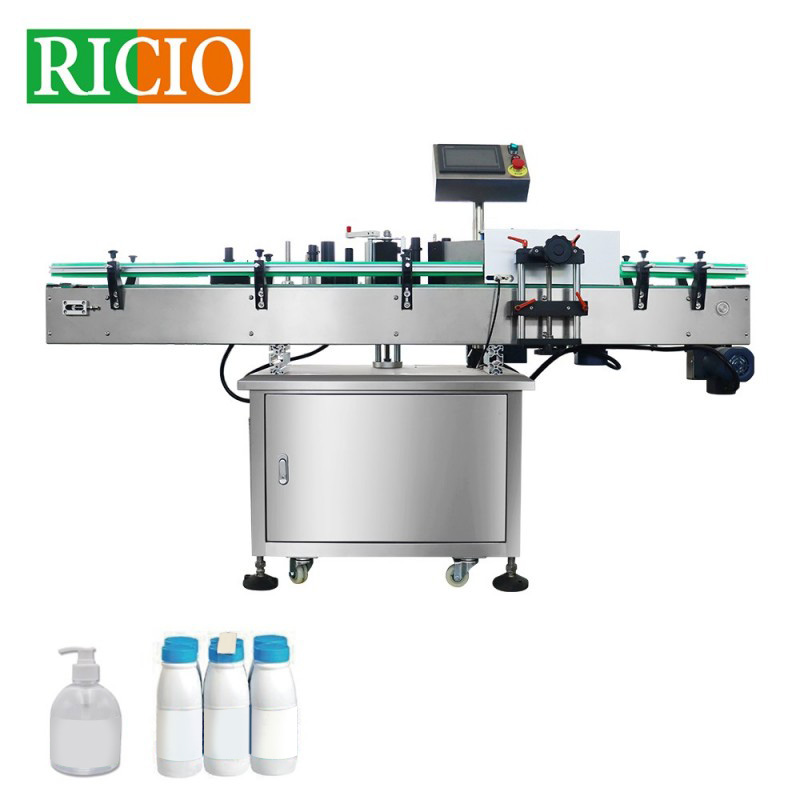 Automatic Round Bottle Labeling MachineThe automatic round bottle labeling machine is designed for high-efficiency labeling of cylindrical containers, ideal for the pharmaceutical, food, chemical, and daily...View Product →
Oval, tapered, and square bottles with rounded edges need position correction rather than pure rotation, because the surface speed changes as the bottle turns. Machines built for that duty add a positioning roller or a servo-driven bottle holder. If your container profile changes, browse the available round bottle labeling solutions before settling on a standard wrap-around head.
Vials, Ampoules, and Small Cylinders
Below roughly 20mm diameter, product handling changes completely. Small glass vials cannot be rotated safely at production speed, so the label is applied with a tamp pad or an air-blow head against a fixed container held in a pocket. Tray-fed designs accept a full nest of vials and index them under the applicator, which keeps placement within about plus or minus 0.5mm on a 15mm label.
Flat Surface, Carton, and Pouch Labeling
Flat products are the easiest to label well and the easiest to label badly. A carton that is 0.5mm out of square will tilt the label, and a flexible pouch that is not fully flattened will wrinkle under the pad. Single-side roll fed labeling works by trapping the product between the conveyor belt and a top hold-down belt, then pressing the label with a tamp pad or an air-blow head at a fixed distance from the registration mark.
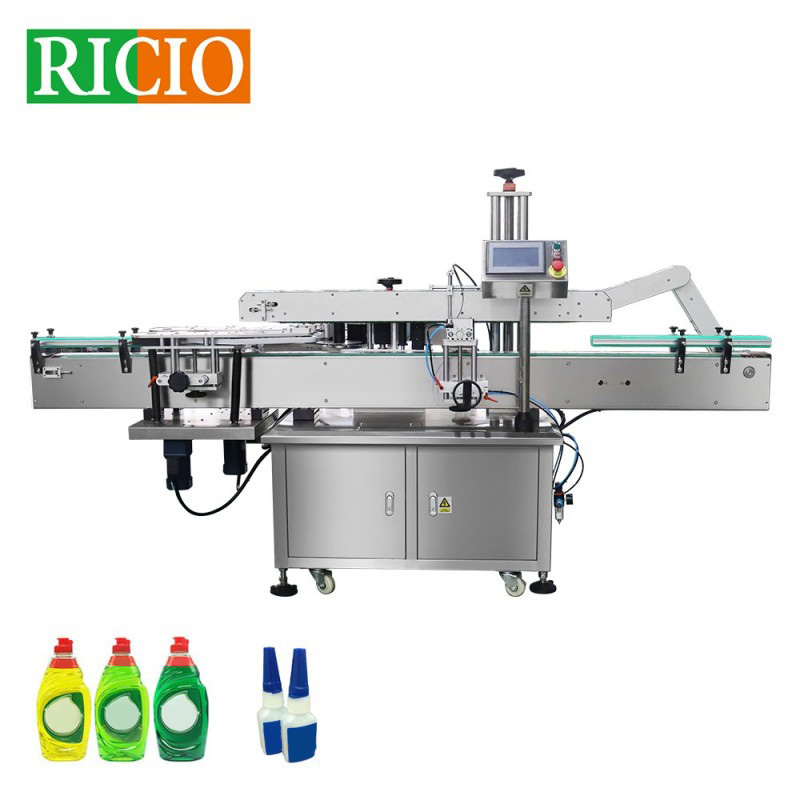
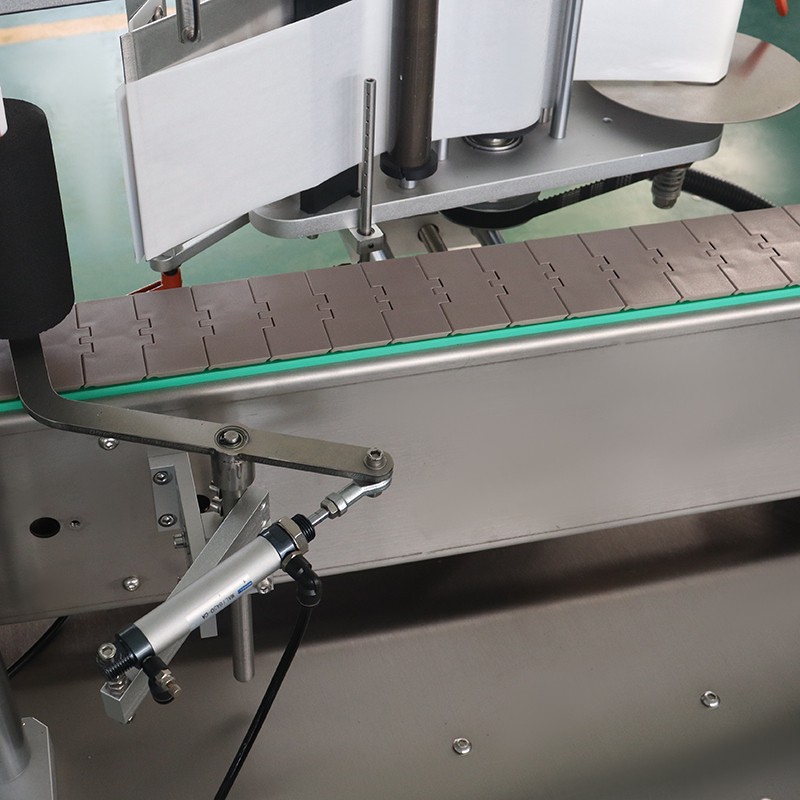 Automatic Single Side Sticker Labeling MachineThe automatic single-sided sticker labeling machine is designed for automatic labeling of square bottles, flat bottles, irregular bottles, and some round containers. I...View Product →
Typical output for a tamp-applied flat label sits between 40 and 120 pieces per minute, limited by pad stroke rather than by the label web. Where the printed carton already carries a registration mark, the applicator can use it as the trigger instead of the product edge, which removes the effect of carton length variation of 1 to 2mm that is normal in folded board.
Pouches and Soft Bags
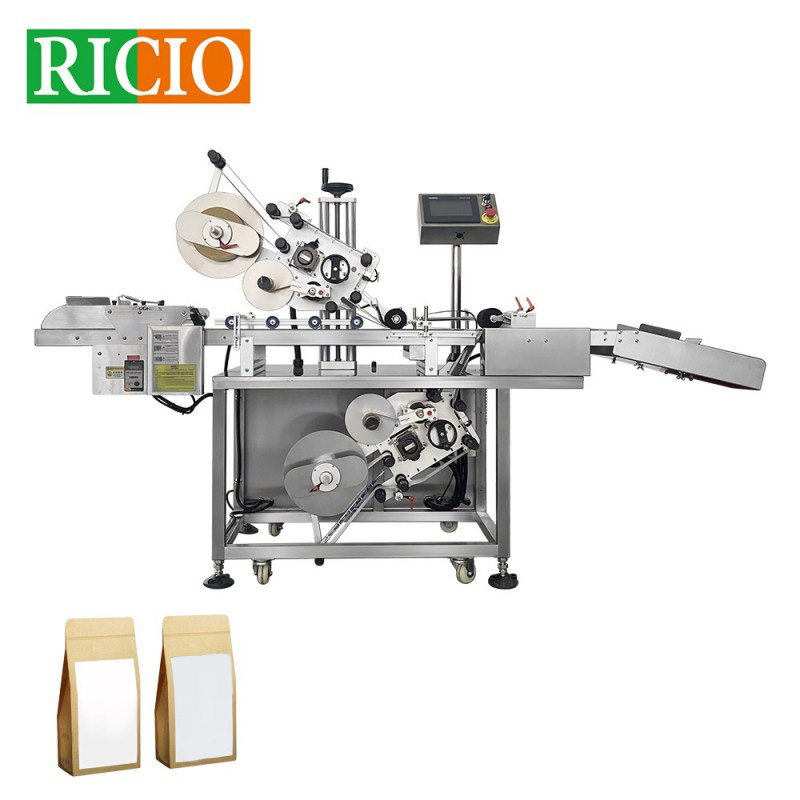
Soft packaging needs a paging mechanism that lifts one pouch at a time from a stack and presents it flat. Without it, two pouches move together and the second one arrives with no label. Air-blow application at a 1 to 2mm standoff is usually preferred here, because a tamp pad can shift a half-empty pouch.
Top, Bottom, and Corner Labeling on Boxes and Pails
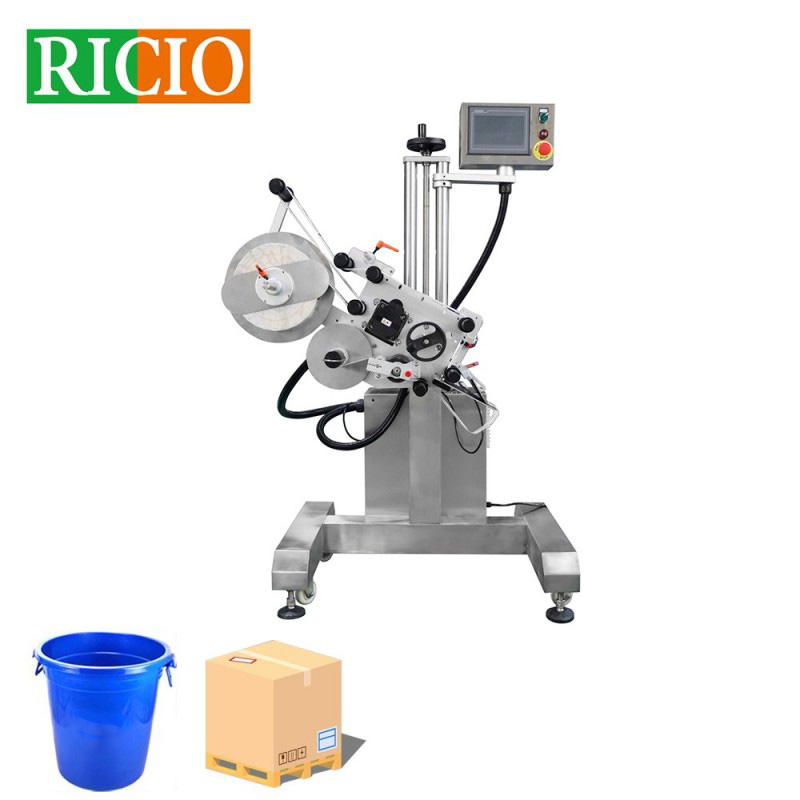
Not every roll fed label goes on the front of a bottle. A large share of installed capacity puts labels on the top of a carton as a shipping or traceability mark, on the bottom of a pail as a batch code, or around a corner as a tamper-evident seal. Each of those placements has its own mechanical answer.
Top labeling uses a tamp or air-blow head mounted above the conveyor, triggered by a sensor at the product leading edge. The main risk is a box that is not square to the conveyor, which shows up as a skewed shipping label. Corner labeling is harder: the label must be pressed onto two perpendicular faces plus the edge between them, so the applicator combines a tamp stroke with a wrap roller or a directional air burst.
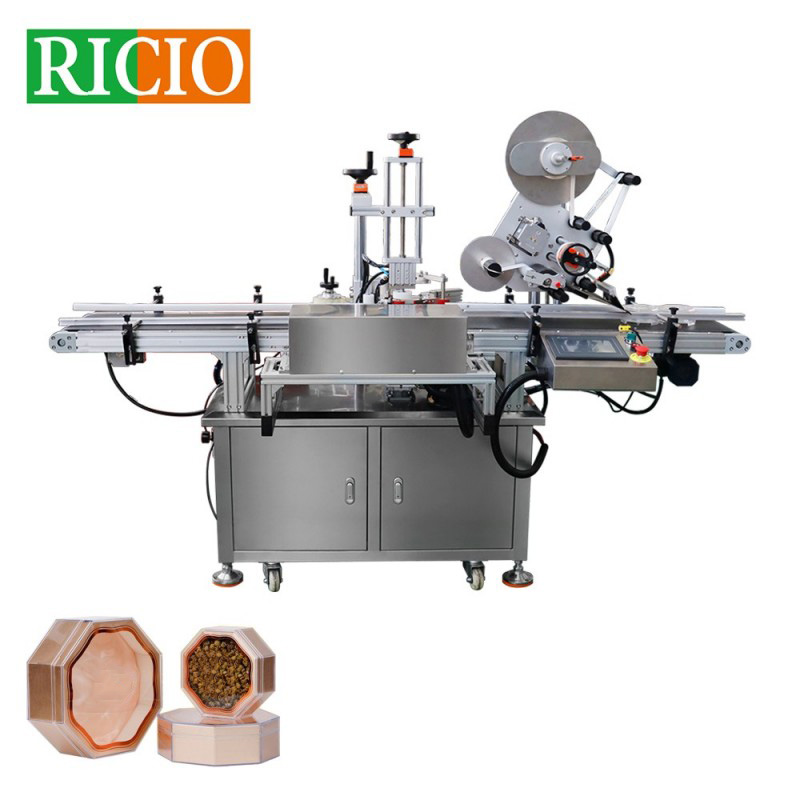
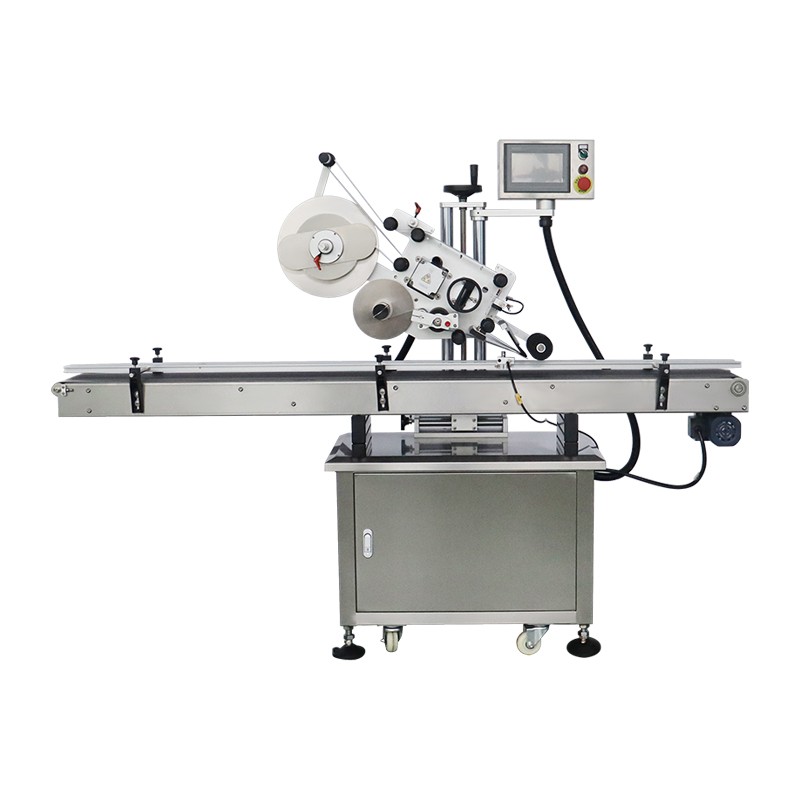 Automatic Top Labeling MachineThe automatic top labeling machine is designed for top labeling of plastic boxes, paper boxes, square containers, flat packages, and other products with a flat surface...View Product →
For pails and drums, weight and inertia change the design again. A 20 litre pail does not accelerate quickly, so the labeler must match the conveyor rather than the other way round, and the applicator needs a longer stroke to reach a recessed lid or a conical body. A 5 to 10mm difference in pail height between suppliers is common, and it will move the label if the tamp position is fixed. Adjustable stroke or a sensor-measured height solves it.
Label Rolls and Materials That Decide Your Uptime
Ask an experienced operator what stops a roll fed line and the answer is rarely the machine. It is the web. Liner thickness, die-cut quality, splice placement, and storage conditions all show up as downtime that gets blamed on the applicator.
- Liner thickness: 30 to 40 micron liners allow longer rolls per diameter but break more easily under high tension. Thicker 60 to 80 micron liners survive aggressive web take-up at the cost of more frequent roll changes.
- Die-cut precision: A die that cuts 0.3mm into the liner is fine. A die that cuts through the liner creates a break point that fails at speed.
- Splices: Every joint in the roll is a potential stop. Confirm the maximum number of splices per roll and where they sit, because a splice passing the peel plate at 200 labels per minute arrives without warning.
- Film behaviour: PE and PP labels stretch 1 to 3 percent under tension, which shifts placement if the machine does not compensate. Clear film on clear containers also reveals every air bubble, so surface cleanliness and wipe pressure matter more than on paper.
- Storage: Rolls stored near a loading dock in humid conditions can absorb moisture and curl at the edges. A storage area at roughly 20 to 25 degrees Celsius and moderate humidity keeps the web flat.
Give your label converter the machine's maximum web speed, its peel plate radius, and its rewind torque. Converters who know those three numbers supply rolls that run, and the price difference between a good roll and a cheap roll is usually less than the cost of one hour of lost output.
Speed, Accuracy, and the Real Cost of Both
Speed figures are quoted at the labeler, not at the shipping pallet. A machine rated at 150 labels per minute on a 60mm label will not deliver 150 finished cases if the line stops for a jam every 20 minutes.
Consider a realistic example. A line runs at 150 containers per minute for an eight-hour shift with 85 percent effective uptime, which is a normal figure for a well-maintained line with one changeover. That produces 150 multiplied by 60 multiplied by 8 multiplied by 0.85, or 61,200 labelled containers per shift. Raise the machine speed to 180 per minute but lose 10 percent more time to web breaks and you end with fewer finished units, not more.
Accuracy behaves the same way. A servo-driven machine with encoder feedback on the conveyor typically holds plus or minus 0.5mm. A stepper machine with a mechanical wipe-on belt typically holds plus or minus 1mm. The gap matters when labels are small, when a label must sit inside a moulded panel, or when two labels appear on the same face and the eye compares them side by side.
Where the Waste Actually Goes
- Setup labels: expect 10 to 30 labels consumed per changeover while tension and registration are dialled in.
- End of roll: the last 1 to 2 metres of liner often cannot be used because the web loses tension near the core.
- Rejects: a container that arrives misaligned gets a misplaced label and becomes scrap, which costs the product as well as the label.
- Speed chasing: pushing a machine 15 percent past its stable rate commonly doubles misplacement rates before it increases throughput.
Controls and Sensors: Stepper or Servo, and Print-and-Apply
The control architecture determines how gracefully a machine behaves when the line speed changes. A stepper-driven web feed works well when conveyor speed is constant and labels are moderate in size. A servo-driven feed with an electronic cam profile can slow the web precisely during the application window and accelerate between products, which reduces label bounce on small or delicate items.
Whichever drive is used, the machine needs feedback from the conveyor: a shaft encoder or a proximity sensor that reports actual line speed several times per second. Without it, a 3 percent conveyor speed variation on a wrap-around application can translate into 2mm of placement drift at production speed.
Print-and-Apply and Variable Data
When each label carries unique content, such as a batch number, serial, or barcode, a thermal transfer printer is mounted over the web and prints on the moving label before it is applied. Typical print resolution of 300 dots per inch supports barcodes down to around 5 mils, and print speeds between 150 and 300mm per second must be matched to the line rate. The control logic needs a buffer: if the printer pauses, the applicator must either hold the product or reject it rather than apply a blank label.
Missing-label detection is worth specifying on any line where an unlabelled container reaching the market is unacceptable. A gap sensor or a vision camera after application confirms that a label is present and, in vision-equipped systems, that it sits within the placement window. The reject output then drives an air jet or a pusher. Without it, operators become the inspection system, and that role lasts about two hours into a night shift.
Line Layout and Integration Points Most Buyers Forget
A roll fed labeler is a component, not a standalone machine. How it is fed and how fast it is fed decide the placement accuracy you actually achieve.
- Product spacing: aim for a consistent 100 to 200mm gap between containers. Irregular gaps force the applicator to wait, which multiplies cycle variation along the shift.
- Infeed stability: a timing screw or a metering wheel should deliver the container in the same position every cycle. If the container wobbles before it reaches the wipe-on belt, no amount of servo tuning will fix the label.
- Upstream and downstream buffering: at least 30 seconds of accumulation before the labeler absorbs a stoppage at the filler and prevents a cascade of scrap.
- Service access: roll changes happen every 20 to 60 minutes on a fast line. If the spindle faces a wall or a pipe run, operators will load rolls badly and you will see the consequences in the reject bin.
- Environment: flour dust, condiment powder, or humid washdown areas affect sensor reliability. Dust on a gap sensor reads as a missing label and stops the machine.
If the line runs different products on different days, treat recipe storage as a functional requirement rather than a convenience. A machine that lets an operator recall a stored label pitch, offset, and speed setting by product code cuts changeover from 15 minutes to under 5 and removes the variability that comes with manual adjustment.
Procurement Checklist and Common Buying Risks
Most roll fed labeling projects fail for one of three reasons: the machine was specified from a catalogue instead of from a trial, the label web was never tested at production speed, or spare parts were treated as an afterthought. Every one of those is avoidable with a short, disciplined evaluation.
- Send your actual containers, your actual labels, and your actual label roll to the machine builder. A trial on the customer's own packaging is worth more than a page of quoted specifications.
- Ask for a factory acceptance run of at least 500 containers in one continuous stretch, with placement measured at the start, middle, and end of the run.
- Record the changeover time yourself. Load a fresh roll, switch the recipe, and time the first acceptable labelled container.
- Confirm the consumable spares list and expected replacement interval for the peel plate, drive roller, application belt, and sensors.
- Ask for the electrical and air schematics plus the controller input and output list at handover, so your maintenance team can troubleshoot without a service call.
- Clarify the response commitment in writing, including how quickly a technician or a spare part reaches your site.
If you are comparing machine types across the whole line rather than a single unit, the label application machine selection and ROI guide sets out how throughput, changeover, and material cost interact over a multi-year horizon.
Risks That Show Up After Installation
- A machine sized exactly to today's output has no headroom. A 15 to 20 percent speed margin costs little at purchase and much less than a replacement line later.
- A roll diameter that exceeds the unwind spindle's capability forces more frequent roll changes and more splice-related stops.
- Containers that are 1mm out of tolerance from the moulding supplier will produce visible skew on long labels. Audit incoming containers before blaming the applicator.
- Compressed air that carries moisture damages applicator valves. A dryer and filter at the point of use is a small cost against repeated air-blow failures.
Daily and Weekly Maintenance That Protects Placement Accuracy
Roll fed machines are mechanically simple, and that is exactly why small maintenance habits pay off. Adhesive residue builds up on the peel plate and drive roller, and the resulting drag shows up as inconsistent label placement long before it causes a visible failure.
- After every shift: wipe the peel plate, drive roller, and applicator belt with a lint-free cloth and a mild solvent. Remove adhesive build-up rather than spreading it.
- Daily: check web tension by hand at the unwind, and inspect the gap sensor lens for dust. A dusty lens produces phantom missing-label alarms.
- Weekly: verify belt tension on the wipe-on assembly, check the rewind slip clutch setting, and drain the air line filter.
- Monthly: inspect the drive roller surface for glazing, confirm the registration sensor responds to a gap within its specified range, and re-check the placement tolerance with a gauge on 20 consecutive containers.
- Annually: review the wear parts that fail silently, including the applicator belt, tamp pad surface, and the spindle brake friction disc.
Keep a short log of placement measurements taken after each changeover. A drift of 0.5mm over a month reads as normal wear of a belt or a roller, and it is far easier to schedule a 20 minute replacement than to explain a shelf full of off-centre labels.
Frequently Asked Questions
What is a roll fed labeling machine?
It is a labeling machine that takes pressure-sensitive labels from a continuous roll, separates each label from its liner at a peel plate, and applies it to a container or package with a wipe-on belt, a tamp pad, or an air-blow head. The empty liner is rewound on a second spindle. It differs from wet glue systems, which use pre-cut paper labels and a glue applicator.
How fast can a roll fed labeling machine run?
For small labels on round containers, output commonly sits between 60 and 200 pieces per minute. Flat surfaces applied with a tamp pad typically run 40 to 120 pieces per minute because pad travel sets the cycle. Very short labels on a servo-driven wrap-around head can exceed 250 per minute, but only when the container handling upstream is equally stable.
What label roll sizes can these machines accept?
Most industrial units accept a 76mm core and a maximum roll outside diameter between 300mm and 400mm. Web width follows your label height plus a small margin. Confirm the winding direction, that is whether the label faces outward or inward on the roll, because a mismatch means the web runs through the peel plate backwards.
Can a roll fed labeler apply clear film or transparent labels?
Yes, and this is one of the strongest reasons to choose roll fed over wet glue. Clear PP and PET labels need a clean, smooth container surface and slightly higher wipe pressure. On a transparent container, trapped air under a clear label becomes visible immediately, so surface cleanliness and consistent application pressure matter more than on paper stock.
How accurate is placement on a roll fed machine?
A servo-driven machine with conveyor encoder feedback typically holds plus or minus 0.5mm on a well-controlled product. A stepper-driven unit with mechanical wipe-on usually holds plus or minus 1mm. Actual results depend more on container stability and label die-cut consistency than on the drive type.
What happens if the label gap varies across the roll?
The registration sensor triggers on the gap, and the controller repositions the web each cycle. If the gap varies by more than about 0.5mm, the correction becomes visible as a small horizontal shift from one label to the next, which is very obvious on small pharmaceutical labels. Ask your converter for the gap tolerance held across a full roll.
Is a servo feed worth the extra cost over a stepper?
It depends on what hurts today. Servo feed helps when labels are short, when the line speed varies, or when placement tolerance is tight, because the web can decelerate during application. On a constant-speed line with 60mm or larger paper labels on rigid containers, a stepper with a mechanical wipe-on often performs within tolerance at lower cost.
How long does a changeover take?
Changing a label roll takes a few minutes. Changing the product usually takes 5 to 15 minutes on a roll fed machine if the format parts are tool-less and the recipe is stored in the controller. Adding a new label size with different pitch and offset can add another 10 minutes on the first run.
Can the same machine label bottles and flat cartons?
Rarely on the same head without changes. Wrap-around labeling relies on container rotation, while flat labeling relies on a tamp or air-blow action against a stationary surface. Some builders offer interchangeable applicator modules, but a dedicated head for each product family usually delivers better accuracy and fewer daily adjustments.
What should I check before signing a purchase order?
Run your own containers and your own label rolls on the machine, measure placement across at least 500 consecutive pieces, time the changeover yourself, and list the consumable spare parts with their prices. Ask how quickly a technician can reach your site and what documentation comes with the machine, including the electrical schematic and the controller input and output list.
The machine that labels your bottles correctly at 120 pieces per minute for a full shift will outperform a machine rated at 200 that stops every 40 minutes, and the difference is almost never in the headline speed figure. It sits in web tension control, container stability at the point of application, and how quickly an operator can load a fresh roll and get back to production.
Start with the label roll, then the container, then the placement tolerance you genuinely need, and only then compare applicator types. That order turns a wide and confusing machine market into a short list of two or three options you can test with your own packaging before you commit.
 +86 13681850339
 sales@raxpack.com
 Building 6, No. 477 Tiefeng Road, Baoshan District, Shanghai, China
- Tabletop Labeling Machine
- Round Bottle Labeling Machine
- Automatic Tube Labeling Machine
- Pouch Labeling Machine
- Rotary Labeling Machine
- Syringe Labeling Machine
- Top Labeling Machine
- Single Side Sticker Labeling Machine
- Double Side Labeling Machine
- Bucket Labeling Machine
- Bottom Labeling Machine
- Corner Label Applicator
- Waist Sealing Labeling Machine
- Square Bottle Labeling Machine
